The nurse is caring for a client experiencing septic shock. The client's blood pressure is unstable and requires multiple intravenous (IV) vasopressor support.
To determine if the client is meeting the treatment goals, the nurse anticipates the primary healthcare provider (PHCP) will order
The nurse is caring for a client experiencing septic shock. The client's blood pressure is unstable and requires multiple intravenous (IV) vasopressor support.
To determine if the client is meeting the treatment goals, the nurse anticipates the primary healthcare provider (PHCP) will order
A. an arterial line.
[65%]
B. a chest tube.
[1%]
C. mechanical ventilation.
[8%]
D. an indwelling urinary catheter.
[26%]
Statistics
Subject/Lesson
Subject
Critical Care
Lesson
Critical Care Concepts
Client Need
Test Plan
Physiological Adaptation
Related Topic
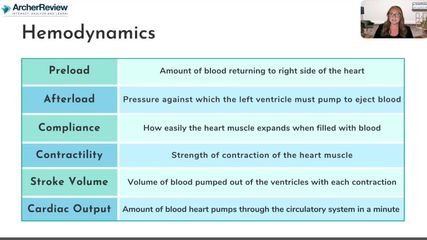
Hemodynamics
Item Type
Item Type
Analysis
Explanation
Choice A is correct. An arterial line will likely be ordered for a client receiving multiple intravenous (IV) vasopressors. The PHCP will place this line to obtain continuous blood pressure, which will be more accurate than intermittent blood pressure monitoring via an external cuff. The vasopressor dose is titrated to keep the blood pressure in the target range. An arterial line is also advantageous because arterial blood gas may be collected without requiring an arterial puncture.
Choice B is incorrect. There is no relationship between blood pressure instability and a chest tube. Both devices would be effective for respiratory emergencies such as pneumothorax, severe hypoxia, or another respiratory ailment.
Choice C is incorrect. Mechanical ventilation would not be ordered to determine the efficacy of vasopressor treatment. Mechanical ventilation is provided to individuals who have experienced respiratory failure.
Choice D is incorrect. An indwelling urinary catheter may be used in shock to determine if a client is responding to fluid replacement. However, this would be unhelpful in assessing the effectiveness of vasopressor support.
Learning Objective
Recognize that an arterial line is commonly used to accurately monitor the blood pressure in patients with shock and those on vasopressor support.
Related Videos
4 Key Topics
Central Venous Catheters & Arterial Lines
27.3 Critical Care Cardiovascular System
Arterial Lines
11.1 Vascular Access & Hemodynamic Monitoring
Additional Info
✓ A physician may place an arterial line to determine the responsiveness to vasopressor treatment. The arterial line will provide continuous blood pressure monitoring.
✓ Additionally, this hemodynamic monitoring procedure may allow the nurse to obtain ABGs without needing multiple arterial punctures.
