The nurse in the emergency department (ED) is caring for a 10-year-old client.
Item 4 of 5
- Nurses' Notes
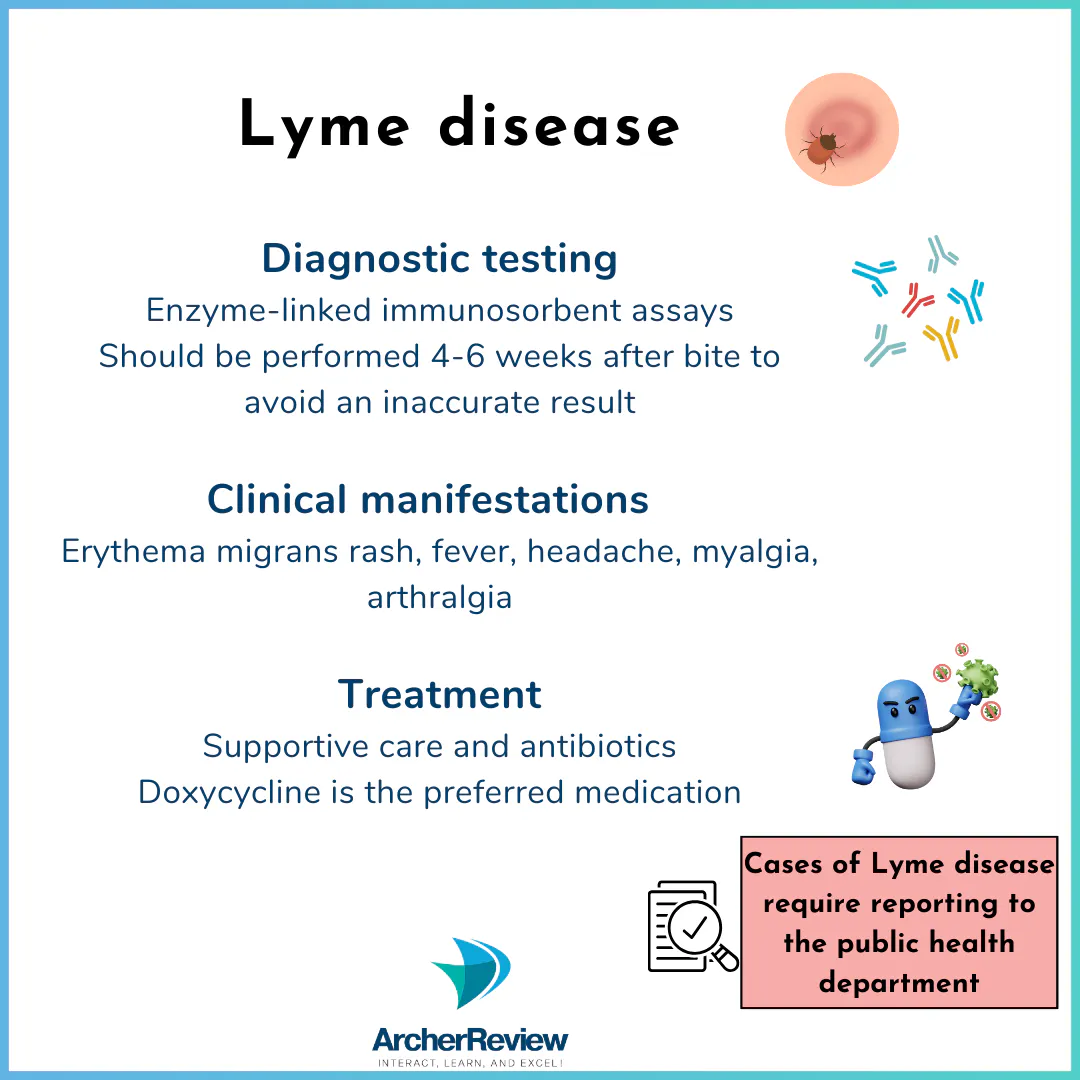
1322: 10-year-old client and his parents report an 8-day history of a brownish-raised lesion over the back of his left leg. The parents report that the size of the rash has increased. The parents report returning from a one-week camping trip three weeks ago. The parents deny efficacy with over-the-counter antihistamine creams. The client's parents deny that the child has had a fever but has felt 'warm' occasionally and endorsed an intermittent headache. They report an area of firmness in the child's groin. On assessment, there was an erythematous, raised, nonpainful, oval patch on the back of his left leg. This was an enlargement of an inguinal lymph node. The child is alert and fully oriented and denies any pain. Peripheral pulses palpable 2+. No cyanosis or edema in the extremities. Lung sounds clear bilaterally. The parents report that the child did not receive the seasonal influenza vaccine. He currently takes a multivitamin for iron deficiency anemia and was hospitalized one year ago for an appendectomy. The parents state that the child’s sibling had influenza one month ago. Vital signs: T 98.8°F (37.1°C); HR 78 beats/min; RR 16 breaths/min; BP 110/76 mm Hg. SpO2 97% on room air.
- Progress Notes
1401: The client was evaluated. The rash is localized, raised, and appears like a bullseye. The client has inguinal lymphadenopathy. The client's recent camping trip supports the probability of a vector-borne illness—specifically, Lyme disease.
The nurse reviews the physician's progress note and plans care for this client.
For each potential intervention, click to specify whether the intervention is indicated or not indicated for the client.
The nurse reviews the physician's progress note and plans care for this client.
For each potential intervention, click to specify whether the intervention is indicated or not indicated for the client.

| Potential Interventions | Indicated | Not Indicated |
|---|---|---|
Obtain confirmatory testing via urine specimen | ||
Notify the local health department if confirmation testing comes back positive | ||
Request an order for antiviral medication | ||
Prepare the client for lumbar puncture |
Statistics
Subject/Lesson
Subject
Child Health
Lesson
Infectious Disease
Client Need
Test Plan
Physiological Adaptation
Related Topic
Illness Management
Item Type
Item Type
GenerateSolutions
Explanation
Interventions indicated
- Notify the local health department if confirmation testing comes back positive
Lyme disease is a reportable condition, meaning confirmed cases must be reported to public health authorities. Rationale: Reporting helps track disease prevalence and monitor outbreaks in endemic areas.
Interventions not indicated
- Obtain confirmatory testing via urine specimen.
The preferred confirmatory testing is two-tiered serologic testing (ELISA followed by Western Blot). Rationale: Lyme disease is diagnosed based on clinical presentation and confirmed with blood tests, not urine.
- Request an order for antiviral medication
Lyme disease is caused by the bacterium Borrelia burgdorferi, not a virus. Antibiotics (doxycycline, amoxicillin, or cefuroxime) are the appropriate treatment.
- Prepare the client for lumbar puncture
A lumbar puncture (LP) is only needed if neurological symptoms are present, such as meningitis symptoms (severe headache, neck stiffness, photophobia) or cranial nerve involvement (facial palsy). While the client has experienced intermittent headaches, the current presentation lacks fever, nuchal rigidity, and other signs of meningitis.
Related Videos
4 Key Topics
Infections by system
23.3 Infection Control & Infectious Diseases
Bacterial Infections
25.5 Infectious Skin Conditions
Additional Info