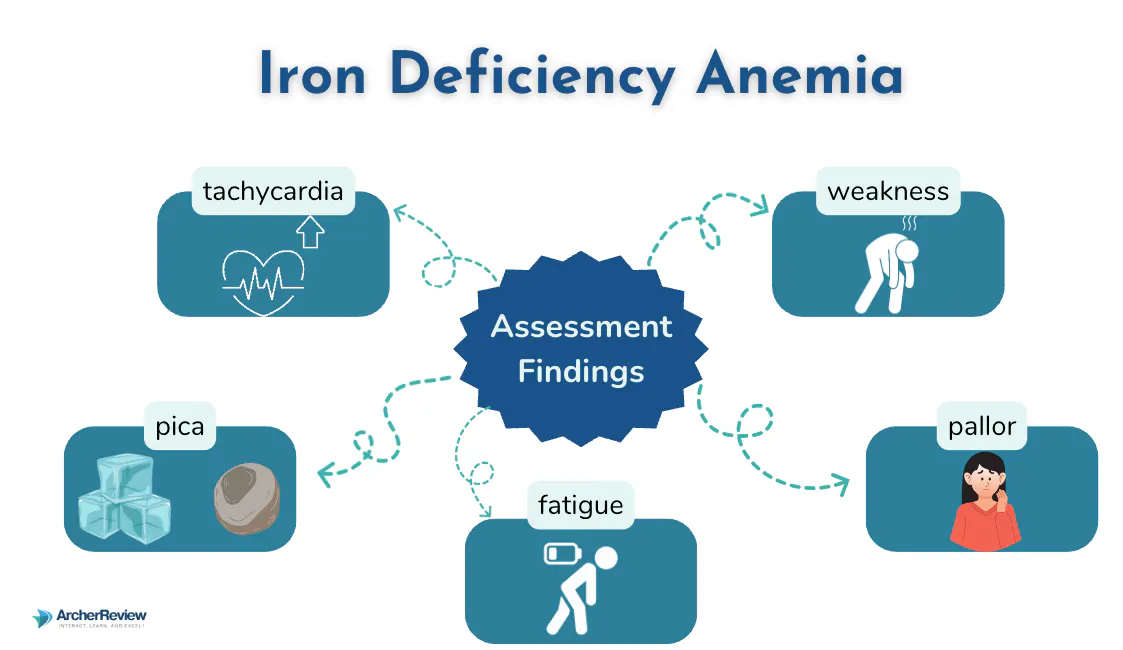
The nurse is assessing a child with iron deficiency anemia.
Which assessment findings would support a diagnosis of iron deficiency anemia? Select all that apply.
The nurse is assessing a child with iron deficiency anemia.
Which assessment findings would support a diagnosis of iron deficiency anemia? Select all that apply.
Statistics
Subject/Lesson
Subject
Child Health
Lesson
Hematological/Oncological
Client Need
Test Plan
Physiological Adaptation
Related Topic
Alterations in Body Systems
Item Type
Item Type
Knowledge/Comprehension
Explanation
Choice A is correct. Tachycardia is an expected assessment finding for a client with iron deficiency anemia. When the client has decreased oxygen delivery to the tissues, the body increases the heart rate to compensate.
Choice B is correct. Pica, the compulsive ingestion of non-nutritive substances (e.g., dirt, ice, clay, paper), is a well-known behavioral symptom associated with iron deficiency, particularly in children. The exact mechanism is not fully understood, but one theory is that pica may be a response to micronutrient deficiency, particularly iron and zinc.
Choice C is correct. Pallor is an expected assessment finding for a client with iron deficiency anemia. Due to low iron levels, there is decreased oxygen delivery to the tissues and reduced perfusion. This causes pallor and other signs of decreased perfusion.
Choice E is correct. Fatigue is a nonspecific finding in anemia because of the decreased circulating hemoglobin that supplies oxygen to organs and tissues.
Choice D is incorrect. Paresthesia—described as numbness, tingling, or “pins and needles” sensations—is not typical of iron deficiency anemia. It is more characteristic of vitamin B12 deficiency (pernicious anemia), which leads to demyelination of peripheral nerves and subsequent neurologic manifestations. Children with iron deficiency anemia may be irritable or inattentive, but they do not develop the neurological deficits seen in B12-related megaloblastic anemia. This makes paresthesia an incorrect choice in this context.
Related Videos
2 Key Topics
Anemia
24.5 Hematologic Disorders
Additional Info
✓ Iron deficiency anemia is the most common worldwide
✓ Children may be affected and are sensitive to the neurocognitive effects
✓ All children are generally screened between 9 and 12 months
✓ Typical presentation is younger than three years old
✓ Manifestations associated with this anemia include pagophagia (craving for ice), pica, fatigue, mild pallor, and tachycardia