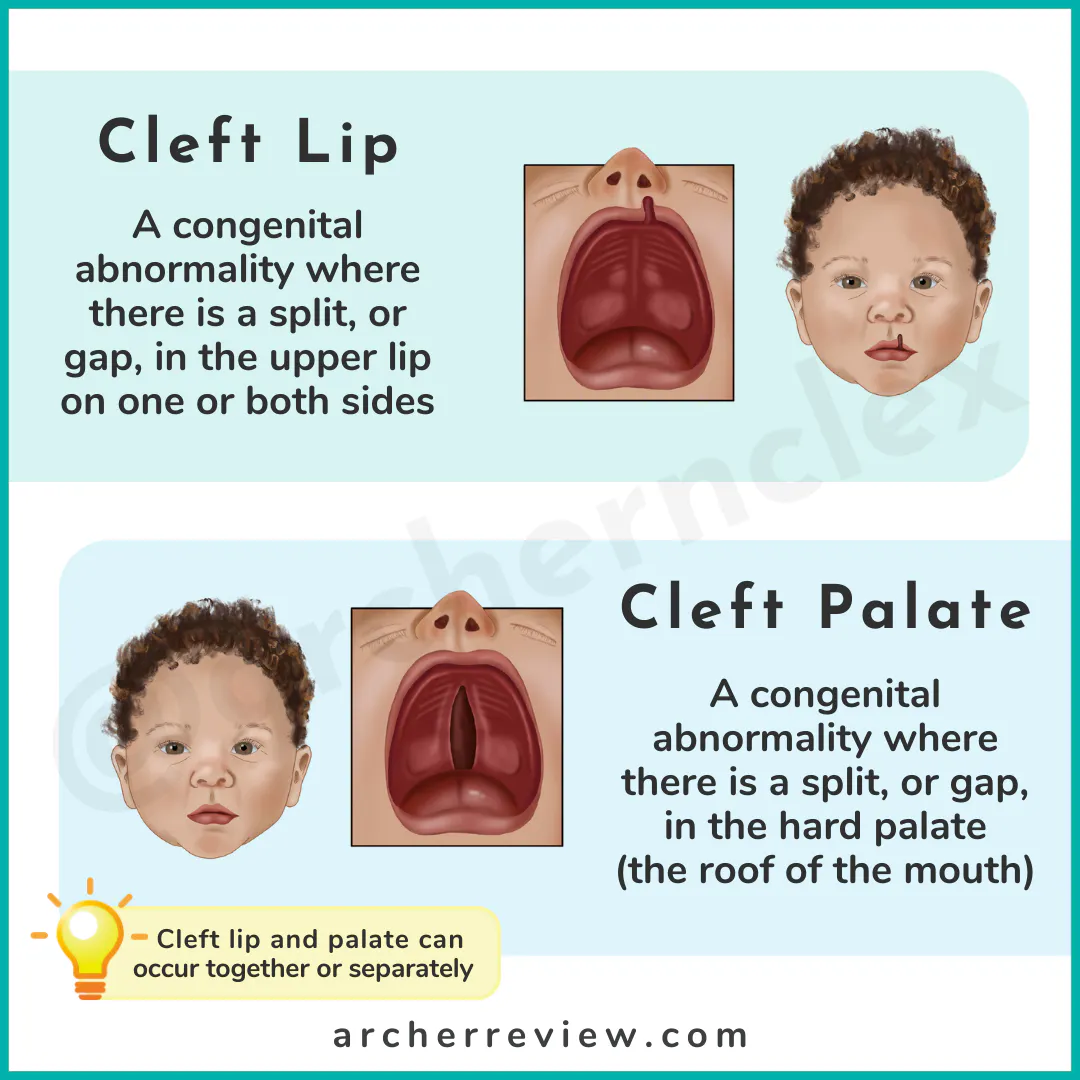
The nurse is caring for a 6 month old infant who has returned to the unit after surgical repair of a cleft lip on the left side.
Which of the following positions should the nurse place this infant in?
The nurse is caring for a 6 month old infant who has returned to the unit after surgical repair of a cleft lip on the left side.
Which of the following positions should the nurse place this infant in?
A. on their stomach
[5%]
B. on their back
[26%]
C. on the left side
[12%]
D. on the right side
[56%]
Statistics
Subject/Lesson
Subject
Child Health
Lesson
Gastrointestinal
Client Need
Test Plan
Reduction of Risk Potential
Related Topic
Potential for Complications from Surgical Procedures and Health Alterations
Item Type
Item Type
Knowledge/Comprehension
Explanation
Choice D is correct. The infant should be placed on the right side. Post-surgical complications include vomiting and aspiration. Lateral positioning prevents aspiration. This infant should be placed on the right side so as not to disturb the surgical site on the left side.
Choice A is incorrect. Infants should not rest or sleep on their abdomens due to the risk of sudden infant death syndrome (SIDS). The “Back to Sleep” campaign emphasizes this to raise awareness that infants should be put to sleep on their backs, not on their abdomens. The only exception to this guideline is for clients who have undergone cleft palate repair. In the case of cleft palate repair, a prone position or lying on the abdomen is acceptable to facilitate drainage of secretions and prevent airway obstruction.
Choice B is incorrect. Placing an infant on their back is not an appropriate position for an infant who has just had cleft lip surgery. If placed on their back, bleeding from the suture line over the lip may be cause the infant to choke in post-cleft lip cases. However, this differs from the cleft palate position. Lying prone after cleft palate surgery is appropriate and preferred because it helps drain secretions, reduces the risk of airway obstruction, and prevents the tongue from falling backward.
Choice C is incorrect. While lateral positioning is appropriate for an infant who has just had cleft lip surgery, this infant had surgery on the left side. Lying on the side of the surgery is not appropriate for patient safety.
Related Videos
4 Key Topics
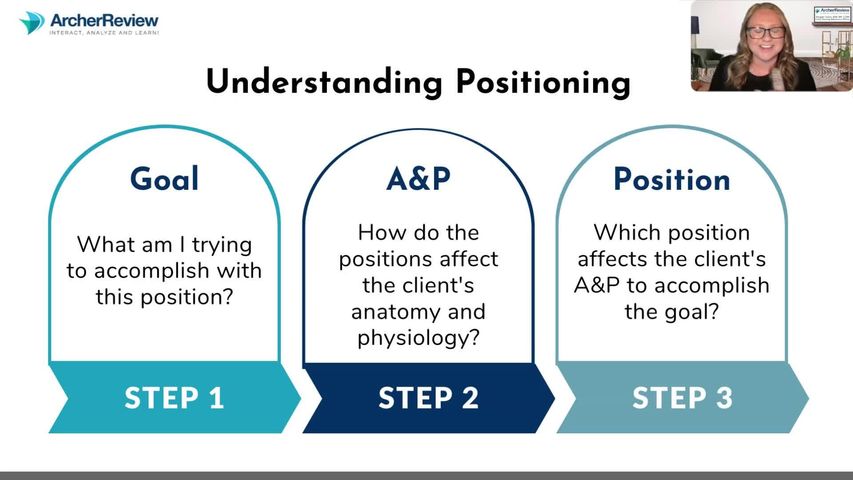
Disease Specific Positioning
9.14 Disease-Specific Positioning
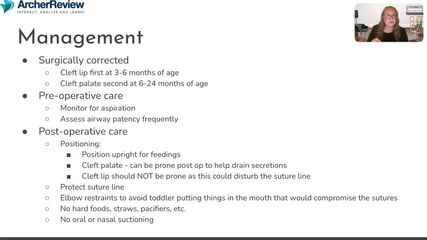
Cleft Lip & Palate
31.10 Craniofacial & Airway/GI Structural Defects
Additional Info
✓ A cleft lip is a congenital malformation in which soft tissue or bone fails to fully connect while the infant develops in utero. A cleft lip may be associated with a cleft palate but can occur as an isolated abnormality.
✓ A infant with a cleft palate repair should be closely monitored postoperatively for signs of airway obstruction, hemorrhage, and laryngeal spasm. The infant should be closely observed for potential airway compromise ,stridor, croup, and difficulty breathing or swallowing.
✓ Following a cleft lip or cleft palate surgery, the nurse should avoid the use of suction or objects in the mouth such as tongue depressors, thermometers, spoons, or straws to protect the surgical sites.