The nurse cares for a 12-year-old client one hour post-operative following transsphenoidal hypophysectomy.
After reviewing the assessment findings, the nurse should take which action? Select all that apply. See the exhibit.
The nurse cares for a 12-year-old client one hour post-operative following transsphenoidal hypophysectomy.
After reviewing the assessment findings, the nurse should take which action? Select all that apply. See the exhibit.
Statistics
Subject/Lesson
Subject
Child Health
Lesson
Endocrine
Client Need
Test Plan
Reduction of Risk Potential
Related Topic
Potential for Alterations in Body Systems
Item Type
Item Type
Application
Explanation
Choice A is correct. This is an excessive amount of urine output for 1 hour and is concerning for diabetes insipidus, given the procedure the client recently underwent. Any urine output greater than 300 mL is alarming, and the healthcare provider should be notified immediately. Diabetes insipidus is a severe complication from neurosurgery that occurs around the pituitary. This amount of urinary output can lead to shock if not treated promptly.
Choice B is correct. Given the assessment, requesting an order for IV fluids is an appropriate nursing action. The nurse should be concerned about the possibility of DI considering the excessive urine output, and no fluid replacement is currently ordered for this client. This is concerning for shock, and IVF should be initiated to rehydrate and adequately replace losses from the urinary output.
Choice C is correct. These findings should be accurately documented to ensure proper follow-up and orders for this client.
Choice E is correct. The client's neurological status should be monitored, as mental status and behavior changes can indicate electrolyte imbalances, such as hyponatremia.
Choice D is incorrect. No oxygen therapy is indicated for this client at this time. The oxygen saturation is adequate on room air.
Related Videos
4 Key Topics
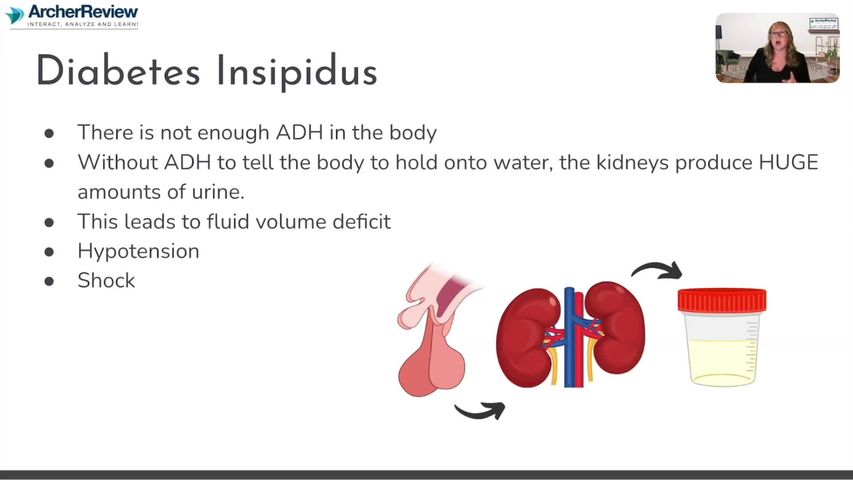
Diabetes Insipidus (DI)
19.7 Water Balance Disorders
Additional Info
✓ Diabetes insipidus (DI) is a condition that affects the balance of fluids in the body. It occurs when the body does not produce enough of a hormone called antidiuretic hormone (ADH), also known as vasopressin, or when the kidneys do not respond properly to ADH.
✓ There are two types of diabetes insipidus: central DI and nephrogenic DI.
- Central DI occurs when there is a problem with the production or release of ADH from the hypothalamus or pituitary gland in the brain. This can be caused by a number of factors, such as a brain injury, infection, tumor, or genetic conditions.
- Nephrogenic DI occurs when the kidneys are unable to respond to ADH properly, even though ADH is being produced and released normally by the body. This can be caused by certain medications, such as lithium, or by genetic conditions.
✓ Neurological monitoring is critical post-surgery to detect signs of increased intracranial pressure (ICP), such as changes in level of consciousness, headaches, or pupil abnormalities.
