The nurse is reviewing the medical record of a 55-year-old male client.
Item 1 of 1
- History and Physical
0818: Client reports severe shortness of breath and swelling in his lower extremities. He reports a 3-day history of fatigue and decreased urine output. During the assessment, the client was alert and fully oriented. He has 2+ pitting pedal edema in the lower extremities. 2+ peripheral pulses in the upper extremities. Bibasilar crackles upon auscultation. Skin is warm, dry, and normal for ethnicity. Normoactive bowel sounds in all quadrants. Vital signs: T 98° F (36.7°C), P 89, RR 18, BP 164/95, pulse oximetry reading 96% on room air.
- Laboratory Results
- Capillary blood glucose 121 mg/dL (6.72 mmol/L) [70-110 mg/dL (4-6 mmol/L)]
- Serum creatinine 2.5 mg/dL (221 mmol/L) [0.6–1.2 mg/dL (53–106 mmol/L)]
- Serum BUN 36 mg/dL (12.9 mmol/L) ([10–20 mg/dL (3.6–7.1 mmol/L)]
- Serum potassium: 5.2 mEq/L [3.5–5 mEq/L (3.5–5 mmol/L)]
- Urinalysis: Mild proteinuria, no hematuria
- Intake and Output
24 hour fluid intake: 1560 mL
24 hour fluid output: 250 mL
- Medical History
- hypertension
- hyperlipidemia
- coronary artery disease
- glaucoma
- diabetes mellitus (type two)
- Current Medications
- carvedilol 6.25 mg p.o. daily
- multivitamin 1 tablet p.o. daily
- lisinopril 10 mg p.o. daily
- simvastatin 10 mg p.o. daily
- ergocalciferol 10000 units p.o. daily
- ethyl eicosapentaenoic acid 2 grams p.o. daily
The nurse is reviewing the client’s assessment data to prepare the client’s care plan.
Complete the diagram by dragging from the choices below to specify what condition the client is most likely experiencing, two (2) actions the nurse should take to address that condition, and two (2) parameters the nurse should monitor to assess the client’s progress.
The nurse is reviewing the client’s assessment data to prepare the client’s care plan.
Complete the diagram by dragging from the choices below to specify what condition the client is most likely experiencing, two (2) actions the nurse should take to address that condition, and two (2) parameters the nurse should monitor to assess the client’s progress.
Actions to Take
- Request a prescription for sodium chloride (normal saline) 500 mL bolus.
- Obtain an order to discontinue the lisinopril.
- Obtain a prescription for a continuous infusion of regular insulin.
Potential Conditions
- Nephrotic syndrome
- Hyperglycemia hyperosmolar syndrome
- Acute kidney injury
Parameters to Monitor
- Peripheral pulses
- Capillary blood glucose
- Temperature
Statistics
Subject/Lesson
Subject
Adult Health
Lesson
Urinary/Renal/Fluid and Electrolytes
Client Need
Test Plan
Physiological Adaptation
Related Topic
Alterations in Body Systems
Item Type
Item Type
NgnAll
Explanation
Potential Conditions
- The client is experiencing acute kidney injury.
- This is supported by the sudden decreased urine output (only 250 mL over 24 hours — very low), elevated serum creatinine (2.5 mg/dL) and BUN (36 mg/dL), hyperkalemia (K+ 5.2), and swelling, bibasilar crackles (signs of fluid overload).
- Recent fatigue and decreased output suggest an acute change rather than a chronic, long-standing process like CKD.
- The client has proteinuria, but it's mild. Nephrotic syndrome usually causes massive proteinuria, severe hypoalbuminemia, and often significant edema, more extreme than this case.
- The blood glucose is only 121 mg/dL — way too low for HHS (which usually has glucose >600 mg/dL).
- The client does have chronic conditions (diabetes, HTN) that risk CKD, but the sudden drop in urine output and recent onset of symptoms point more to an acute problem, not a gradual decline.
Actions to Take
- The client's hyperkalemia requires an order to stop the lisinopril. ACE-I's can cause hyperkalemia. While nephroprotective, they should not be used if the creatinine is elevated.
- The client is experiencing fluid volume overload, and the nurse should request a prescription for a diuretic.
- Dialysis might eventually be needed if AKI gets worse, but hemodialysis is used more acutely, not peritoneal dialysis.
- A fluid bolus would be detrimental to this client as they are in a state of fluid overload.
- Insulin infusion is used for hyperglycemic emergencies. This client's glucose level is mildly elevated, and not clinical hyperglycemia.
Parameters to Monitor
- The client is experiencing pulmonary congestion, and monitoring the client's lung sounds is key.
- The client has hyperkalemia, and the nurse needs to monitor the client's serum potassium level. If the nurse obtains an order for a loop diuretic (such as bumetanide), the client's potassium level may decrease.
- The client's temperature is within normal limits.
- The client's capillary blood glucose, while elevated, is not the priority concern for this client.
NCLEX Strategy Spotlights
Related Videos
2 Key Topics
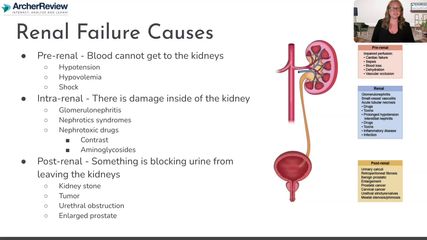
Renal Failure