The nurse is conducting a health screening at a local health fair. Which of the following should the nurse recognize as a risk factor for developing testicular cancer? Select all that apply.
Statistics
Subject/Lesson
Subject
Adult Health
Lesson
Hematological/Oncological
Client Need
Test Plan
Health Promotion and Maintenance
Related Topic
Health Screening
Item Type
Item Type
Knowledge/Comprehension
Explanation
Choices A, B, and D are correct. Risk factors for testicular cancer include cryptorchidism, human immunodeficiency virus (HIV), and family history. Cryptorchidism (Choice A) refers to undescended testicle where the testicle fails to descend to its normal position in the scrotum. Undescended testicles are associated with decreased fertility, testicular torsion, inguinal hernias, and an increased risk of testicular germ cell tumors. HIV-positive ( Choice B) men are more likely to develop testicular cancer. Family history (Choice D) of testicular cancer is another risk factor, with 8-10 times increased risk if the man has a sibling with testicular cancer.
Choices C and E are incorrect. A vasectomy is not a risk factor for testicular cancer. This procedure is done to interrupt each vas deferens to induce male sterility. Herpes Simplex Virus (HSV) is a virus that may be transmitted sexually but does not raise the risk for testicular cancer, unlike HIV.
Related Videos
2 Key Topics
Testicular Cancer
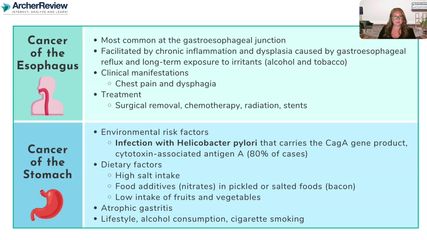
33.4 Major Solid Tumors by Organ System
Additional Info
Testicular cancer, if caught early, has a high cure rate. This cancer most likely occurs between ages 15-34. Risk factors for testicular cancer include Caucasian males, ages 15-34, HIV infection, cryptorchidism, and family history. Testicular cancer may manifest as a dull ache in the scrotum or abdomen, a solid mass on a testicle, scrotal swelling, or heaviness. A scrotal ultrasound is preferred if a primary healthcare provider suspects testicular cancer.
