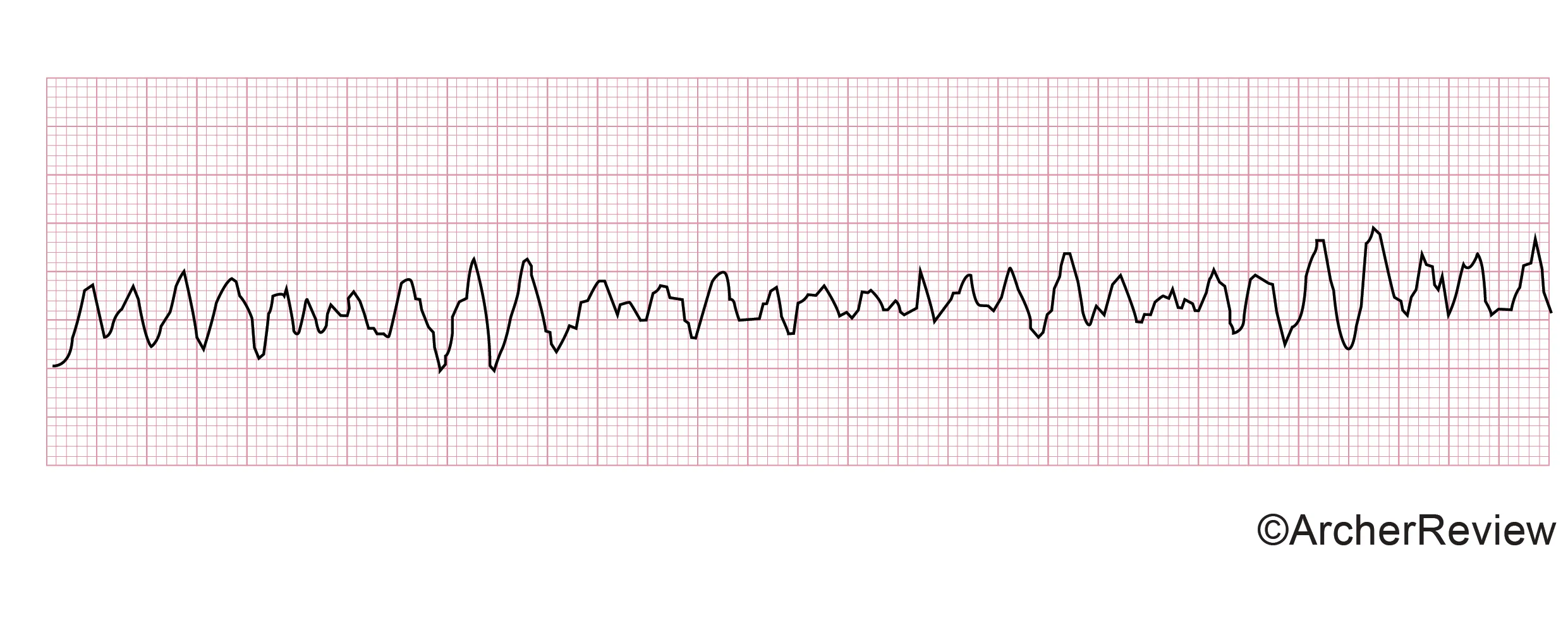
The nurse is caring for a client with the below tracing on the electrocardiogram. The nurse should perform which priority action? See the image below.
 Source : Archer Review
The nurse is caring for a client with the below tracing on the electrocardiogram. The nurse should perform which priority action? See the image below.
A. initiate a code blue.
[36%]
B. establish a peripheral vascular access device
[3%]
C. notify the primary healthcare physician (PHCP)
[11%]
D. assess the client’s airway, breathing, and circulation
[50%]
Statistics
Subject/Lesson
Subject
Adult Health
Lesson
Cardiovascular
Client Need
Test Plan
Physiological Adaptation
Related Topic
Medical Emergencies
Item Type
Item Type
Analysis
Explanation
Choice D is correct. The tracing indicated that the client is experiencing ventricular fibrillation (Vfib). This is a fatal rhythm. However, the nurse's priority action is to immediately establish the validity of this fatal arrhythmia tracing by assessing the client's airway, breathing, and circulation. The nurse should always consider the client first - not the monitor.
Please note that the same question may be presented differently with assessment findings disclosed within the question (e.g., information such as the client is unresponsive and pulse is absent within the question stem); the answer would then be choice A (proceed with CPR and defibrillation because the assessment has already been completed).
Choices A, B, and C are incorrect. None of these options can be implemented until the validity of the rhythm is established. The nurse should clinically validate the rhythm before calling a code blue. Once the client's vitals validate this fatal rhythm, cardiopulmonary resuscitation (CPR), according to Advanced Cardiac Life Support (ACLS) guidelines, should be initiated immediately, and the physician must be notified.
Related Videos
3 Key Topics
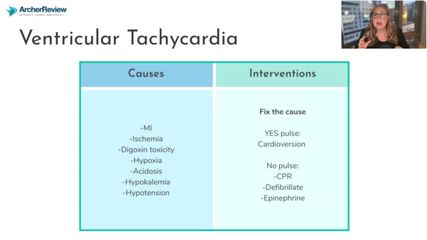
Ventricular Fibrillation
7.6 Ventricular Dysrhythmias & Cardiac Arrest
Additional Info
✓ Ventricular fibrillation is characterized by a complete lack of coordinated contraction, resulting in chaotic electrical activity on the rhythm strip
✓ Due to rapid ventricular contractions, the ventricular filling decreases markedly, leading to a significant decrease in cardiac output
✓ Consequently, a pulse is absent. Clinically, at the time of the event, the client should be pulseless, unconscious, and unresponsive
✓ The priority for any rhythm strip showing a fatal dysrhythmia is to assess the client first and then treat accordingly
✓ Artifact may mimic ventricular fibrillation; the nurse must follow up with the client first
