The infection control nurse delegates tasks to staff to reduce hospital-acquired infections. Which task would be appropriate to delegate to the unlicensed assistive personnel (UAP)?
The infection control nurse delegates tasks to staff to reduce hospital-acquired infections. Which task would be appropriate to delegate to the unlicensed assistive personnel (UAP)?
A. Educate staff members on actions to reduce central line-associated bloodstream infections
[1%]
B. Demonstrating correct handwashing techniques to visitors
[11%]
C. Restocking personal protective equipment (PPE)
[86%]
D. Screening visitors for respiratory infections
[2%]
Statistics
Subject/Lesson
Subject
Leadership & Management
Lesson
Assignment/Delegation
Client Need
Test Plan
Management of Care
Related Topic
Assignment, Delegation and Supervision
Item Type
Item Type
Application
Explanation
Choice C is correct. Restocking PPE is a helpful task and within the scope of a UAP. Having PPE that is accessible is crucial to ensuring adherence by staff and visitors. PPE should be kept in clean and dry areas.
Choices A, B, and D are incorrect. These activities may curb hospital-acquired infections but must be performed by a registered nurse. It is the RN's scope to educate, assess, and provide teaching on reduction strategies for CLABSIs, as this is not part of the education of a UAP. Hand hygiene is probably the most effective strategy to reduce infections, and providing this demonstration should come from the RN. Screening visitors for infection requires assessment and should be delegated to the RN.
Related Videos
2 Key Topics
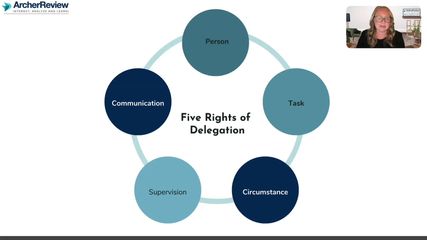
UAP Delegation
15.7 Delegation
Additional Info
Considerations when performing hand hygiene with soap and water
✓ Push wristwatch and long uniform sleeves above wrists. Avoid wearing rings. If worn, remove it during hand hygiene
✓ Do not reach over the sink or touch the inside of the sink because of the risk of contamination
✓ Avoid splashing water on the uniform, which may cause the transmission of microorganisms
✓ Perform hand hygiene using plenty of lather and friction for at least 15 seconds (some agencies recommend 20 seconds)
✓ Keep hands and forearms lower than elbows during washing
✓ Rinse hands and wrists thoroughly, keeping hands down and elbows up
✓ Dry hands thoroughly from fingers to wrists with a paper towel or single-use cloth
