A registered nurse (RN) and a licensed practical/vocational nurse (LPN/VN) are caring for a client who is violent and self-discontinued their peripheral vascular access.
After initiating physical wrist restraints, which of the following tasks may the RN delegate to the LPN?
A registered nurse (RN) and a licensed practical/vocational nurse (LPN/VN) are caring for a client who is violent and self-discontinued their peripheral vascular access.
After initiating physical wrist restraints, which of the following tasks may the RN delegate to the LPN?
A. Collect data on the client's skin integrity.
[55%]
B. Educate the client on the need for restraints.
[4%]
C. Initiate peripheral vascular access.
[25%]
D. Continually assess the client to determine if restraint use is necessary.
[16%]
Statistics
Subject/Lesson
Subject
Leadership & Management
Lesson
Assignment/Delegation
Client Need
Test Plan
Safety & Infection Control
Related Topic
Use of Restraints/Safety Devices
Item Type
Item Type
Application
Explanation
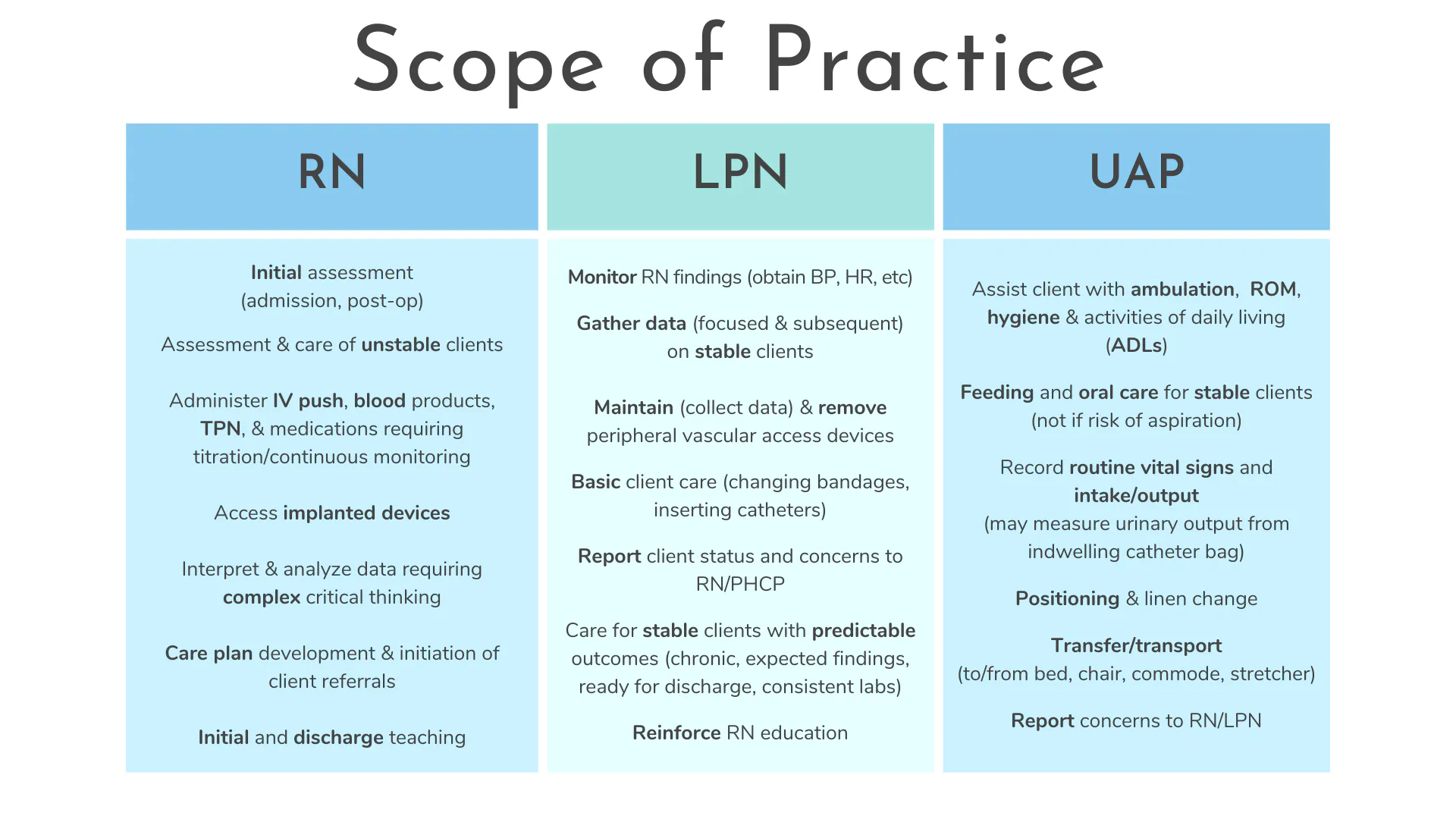
Choice A is correct. It is appropriate for the RN to delegate to the LPN/VN to collect data on the client's neurovascular status (pulse, skin condition, capillary refill) every two hours while the client is restrained. Data collection does not require analysis, and the PN can collect data such as auscultating lung sounds, data collecting on a client's skin integrity, collecting vital signs, and collecting a client's health history.
Choice B is incorrect. The RN is responsible for educating the client on the use of restraints. The LPN/VN may reinforce teaching and validate client understanding.
Choice C is incorrect. The initiation of peripheral vascular access (intravenous line) is within the scope of the RN. While certain states may permit LPN/VNs to initiate peripheral vascular access devices, the NCLEX-PN® test plan does not outline starting IVs as an entry-level skill. This is the consensus the NCSBN has reached.
Choice D is incorrect. Assessing the client to determine the continued need for the restraint will be necessary and appropriate for the RN.
Learning Objective
Identify appropriate interventions for an RN to delegate to an LPN/LVN.
Related Videos
2 Key Topics
LPN Delegation
15.7 Delegation
Additional Info
Restraints should be used as a last resort if alternative methods are ineffective.
- A nurse should never threaten a client with restraints. This is considered assault.
- The nurse may place a violent client in restraints without an order from the primary healthcare provider (PHCP). If this occurs, the nurse has one hour to inform the provider and obtain an order.
- Restraints are never as needed (PRN). They should be discontinued at the earliest possible time.
- When restraining a client, the reason must be explained, and the behavior the client needs to demonstrate for the restraints to be discontinued.
- The nurse should observe the client at frequent intervals to offer nutrition & toileting, assess their behavioral status, obtain vital signs, and provide a range of motion. These intervals are determined by the facility and the type of restraint—the more restrictive the restraint and the younger the client, the more frequent assessment.
- Restraints must be able to quickly be removed via a quick-release buckle (knots are no longer recommended).
- The nurses’ documentation must be comprehensive, describing the reasoning for the restraints, alternatives utilized, the education provided to the client, the type of restraint used, how it was secured, and the ongoing behavior necessary to continue the restraint. The nurse should also document the intervals at which the restraints were released.