A hospitalized client tells the nurse that she has a living will prepared and that her lawyer will be bringing the will to the hospital today for witness signatures. The client asks the nurse to help her obtain a witness for the will. Which of the following is the most appropriate response?
A hospitalized client tells the nurse that she has a living will prepared and that her lawyer will be bringing the will to the hospital today for witness signatures. The client asks the nurse to help her obtain a witness for the will. Which of the following is the most appropriate response?
A. "I will sign as a witness to your signature."
[9%]
B. "Because it is a legal document, you will need to find a witness on your own."
[20%]
C. "Whoever is present at the time will sign as a witness for you."
[10%]
D. "I will contact the nursing supervisor for assistance regarding your request."
[62%]
Statistics
Subject/Lesson
Subject
Leadership & Management
Lesson
Ethical/Legal
Client Need
Test Plan
Management of Care
Related Topic
Legal Rights and Responsibilities
Item Type
Item Type
Application
Explanation
Choice D is correct. The most appropriate response is to escalate the request to a nursing supervisor. This ensures that institutional policies and state-specific legal requirements are followed. While the stem does not explicitly say the nurse is unaware of the legal implications, it is not within the nurse’s typical scope of responsibility to determine eligibility to witness legal documents like a living will. Many hospitals prohibit staff involved in the client’s care from serving as witnesses to avoid any appearance of conflict of interest or coercion. Escalating to the nursing supervisor ensures that the request is handled by someone familiar with institutional policy and legal guidelines, protecting both the client’s rights and the staff’s professional boundaries.
Choice A is incorrect. The nurse should not offer to serve as a witness. Healthcare workers involved in a client’s care are often legally disqualified from witnessing advance directives, including living wills. Even if well-intentioned, doing so may violate hospital policy or state law.
Choice B is incorrect. While this response avoids inappropriate involvement, it is incomplete. The nurse must do more than refuse participation; they should guide the client toward appropriate help. Simply stating that they won’t sign without offering a solution (e.g., contacting someone who can assist) does not meet professional standards of advocacy and support.
Choice C is incorrect. It is outside the nurse’s scope to declare who can or cannot legally serve as a witness. State laws vary widely, and such determinations should be made by someone familiar with institutional legal policy. This response may also sound dismissive or overly authoritative, which can hinder therapeutic communication.
Learning Objective
Identify the correct response when asked to sign as a witness on a client's living will.
Related Videos
2 Key Topics
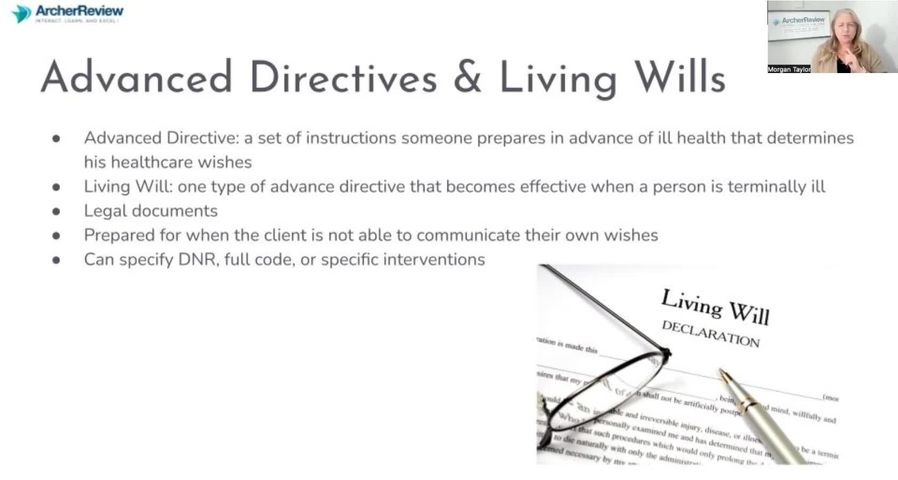
Advanced Directives & Living Wills
15.11 Legal & Ethical Decision-Making Tools
Additional Info
- Living will requirements vary by state.
- A living will becomes effective only when the client cannot communicate their wishes and are permanently unconscious or terminally ill.
- The client can change or revoke the living will at any time.
