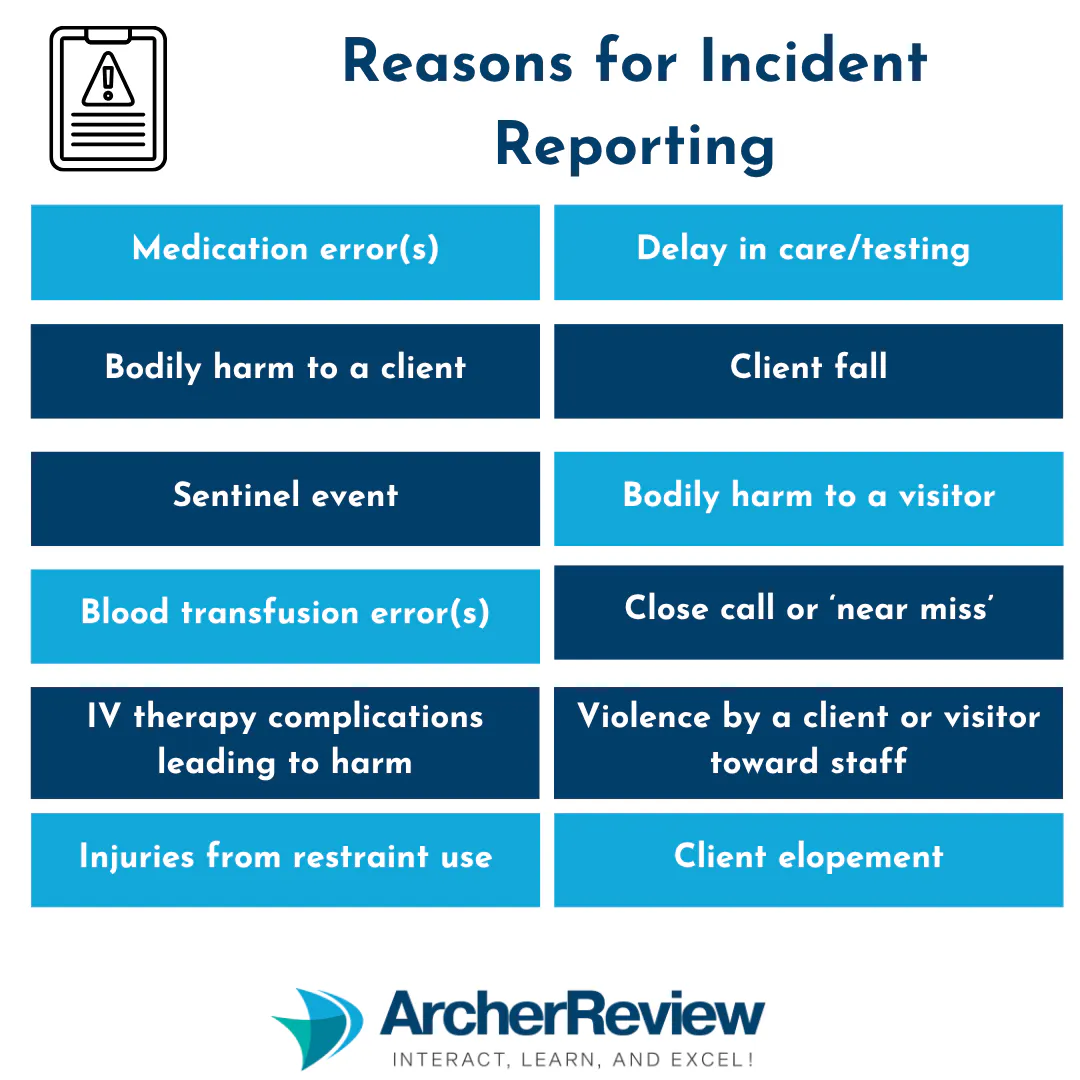
The nurse has attended a staff education program about incident reporting.
It would indicate effective understanding if the nurse states that the primary purpose of incident reporting is to
The nurse has attended a staff education program about incident reporting.
It would indicate effective understanding if the nurse states that the primary purpose of incident reporting is to
A. implement corrective measures needed to prevent recurrence.
[73%]
B. collect data about errors and compare it to different time periods.
[5%]
C. communicate the error(s) to other departments within the facility.
[10%]
D. notify the individual involved of the deviation from the standard of care.
[12%]
Statistics
Subject/Lesson
Subject
Leadership & Management
Lesson
Ethical/Legal
Client Need
Test Plan
Safety & Infection Control
Related Topic
Reporting of Incident/Event
Item Type
Item Type
Knowledge/Comprehension
Explanation
Choice A is correct. The primary purpose of reporting incidents is to prevent client injuries. This is accomplished by notifying risk management about an occurrence that deviates from the standard of care. Risk management can put forth remedies to prevent the error from reoccurring and prevent client injuries.
Choice B is incorrect. Although incident reports may serve as valuable data and later be compared to different periods, this is not the primary purpose of incident reporting.
Choice C is incorrect. Incident reporting is kept confidential and is often shared with the department manager, the charge nurse, and the risk manager. This is not a communicative tool for other departments.
Choice D is incorrect. Incident reporting is not a tool to notify an individual involved. Incident reporting is an internal tool that may be discoverable during litigation.
Learning Objective
Recognize the primary and ultimate purpose of reporting incidents, accidents, medical errors, and sentinel events is to prevent client injuries.
Related Videos
2 Key Topics
Incident Reporting
15.3 Quality, Safety & Risk Management
Additional Info
✓ Incident-reporting systems are set up to report errors, especially safety errors.
✓ They gather data and information about client safety occurrences for organizational learning.
✓ There are three types of incidents: a harmful incident, a no-harm incident, and a near miss.
✓ Incident-reporting systems are part of risk management efforts and are voluntary but set an expectation for reporting.
✓ Barriers to reporting include personal reasons such as fear, accountability, and nurse characteristics, as well as organizational factors including culture, the reporting system, and management behavior.