The nurse reviews the assessment data for a child with acute glomerulonephritis (AGN).
Which of the following assessment findings would be expected?
The nurse reviews the assessment data for a child with acute glomerulonephritis (AGN).
Which of the following assessment findings would be expected?
A. Urine specific gravity of 1.004 [1.005-1.030]
[16%]
B. Proteinuria
[68%]
C. Urinary incontinence
[10%]
D. Hypotension
[5%]
Statistics
Subject/Lesson
Subject
Child Health
Lesson
Urinary/Renal/Fluid and Electrolytes
Client Need
Test Plan
Physiological Adaptation
Related Topic
Alterations in Body Systems
Item Type
Item Type
Knowledge/Comprehension
Explanation
Choice B is correct. Urinalysis shows red blood cells (hematuria) and protein (proteinuria) in a client with AGN. In addition to hematuria, one of the characteristic findings of AGN is the presence of red blood cell casts.
Choice A is incorrect. The urine specific gravity in AGN is high because of the client's low urinary output. This low urinary output causes the urine to concentrate, usually greater than 1.020.
Choice C is incorrect. While urinary symptoms can occur in AGN, incontinence is not a typical finding. Instead, individuals may experience changes in urine color, frequency, or urgency.
Choice D is incorrect. Hypertension, not hypotension, is commonly associated with acute glomerulonephritis. Fluid retention and increased blood pressure are common manifestations due to impaired renal function.
Learning Objective
Understand that the classic clinical manifestations of acute glomerulonephritis (AGN) include hematuria, proteinuria, and fluid retention (edema).
Related Videos
2 Key Topics
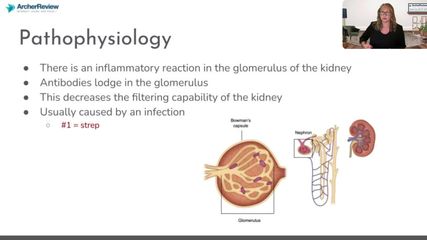
Glomerulonephritis
21.4 Glomerular & Nephrotic Disorders
Additional Info
✓ AGN is a severe condition secondary to many infectious processes, such as streptococcal infections, mononucleosis, and hepatitis.
✓ Clinical features of AGN include oliguria, fatigue (from the uremia), fluid retention, proteinuria, hematuria, and elevation in the blood pressure.
✓ Nursing care aims to prevent the most common complication, fluid volume overload.
✓ The client may have fluid, sodium, and potassium dietary restrictions.
✓ The nurse should monitor the client's intake, output, weight, and blood pressure.
