The nurse is planning care for a child admitted with Rubeola. Which infection control precautions should the nurse implement?
The nurse is planning care for a child admitted with Rubeola. Which infection control precautions should the nurse implement?
A. contact transmission precautions
[15%]
B. droplet transmission precautions
[35%]
C. airborne transmission precautions
[49%]
D. no isolation precautions
[2%]
Statistics
Subject/Lesson
Subject
Child Health
Lesson
Infectious Disease
Client Need
Test Plan
Safety & Infection Control
Related Topic
Standard Precautions/Transmission- Based Precautions/Surgical Asepsis
Item Type
Item Type
Knowledge/Comprehension
Explanation
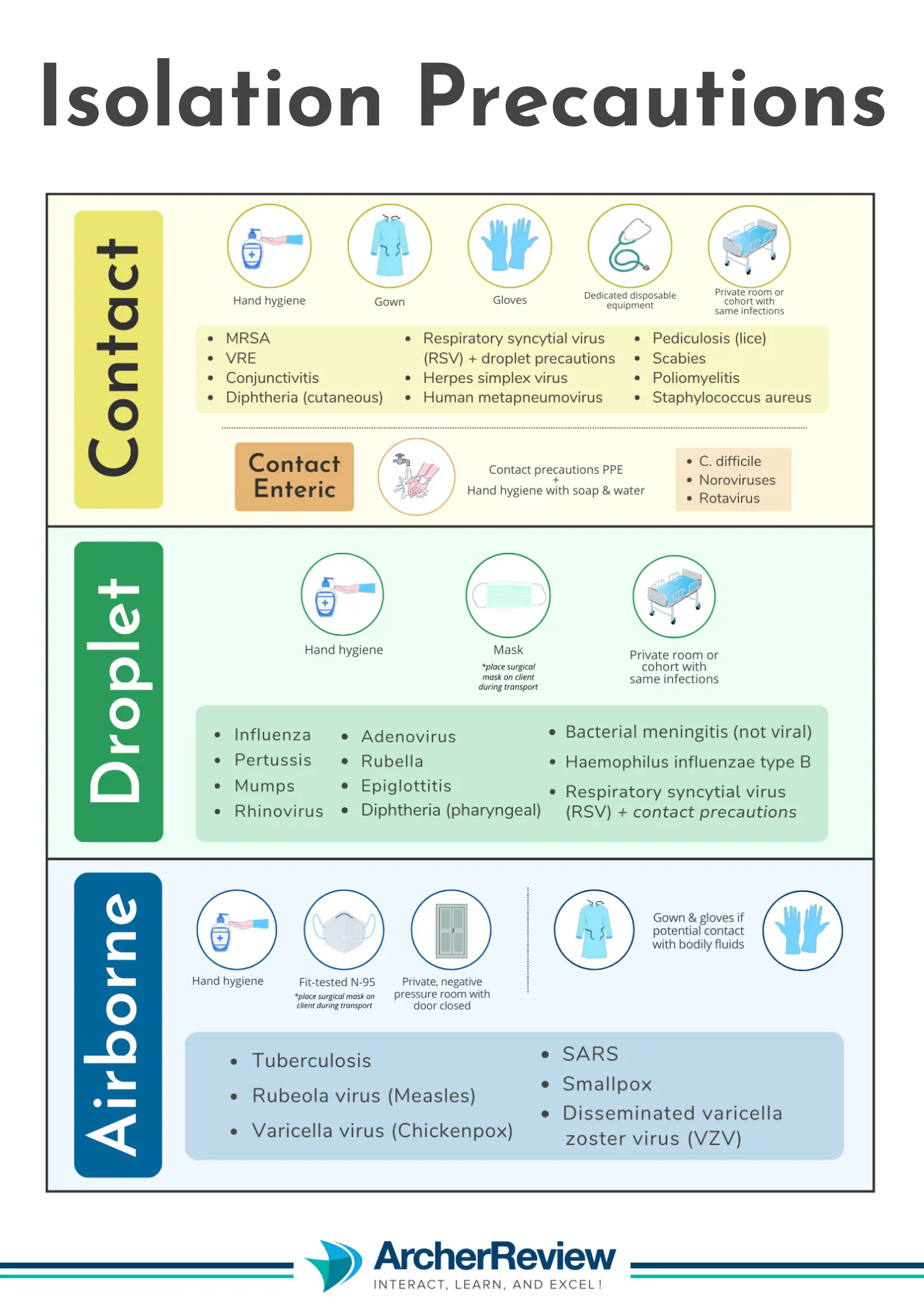
Choice C is correct. The infection control measure that must be initiated is airborne transmission precautions because the mode of transmission for rubeola, or measles, is airborne. This type of transfer occurs when the pathogen is carried in dust or droplets and remains in place for enough time to infect a person exposed to this air. Airborne precautions require the client to be placed in a room with negative airflow. Healthcare staff should don a respirator or N95 mask prior to entering the client's room. The door should remain closed.
Do not confuse rubeola with rubella. Rubeola (measles) requires airborne precautions, whereas rubella requires droplet precautions.
Choice A is incorrect. Contact transmission precautions are used for infectious diseases spread with contact with the client or the client's environment. Contact transmission precautions prevent infections such as C. difficile and shigella.
Choice B is incorrect. Droplet transmission precautions prevent infections from spreading with particle drops larger than 5 microns. Droplet transmission precautions prevent rubella, pneumonia, and scarlet fever.
Choice D is incorrect. Isolation of a client with rubeola requires airborne precautions.
Related Videos
3 Key Topics
Transmission based precautions- Immune System
23.3 Infection Control & Infectious Diseases
Additional Info