The nurse is teaching a client who has hypertension about the newly prescribed medication, diltiazem. Which of the following should the nurse include in the teaching?
The nurse is teaching a client who has hypertension about the newly prescribed medication, diltiazem. Which of the following should the nurse include in the teaching?
A. "A nagging cough can occur as a side effect of the medication."
[7%]
B. "This medication may cause you to go to the bathroom more often."
[4%]
C. "Avoid taking the medication with grapefruit juice."
[82%]
D. "You will need to increase your dietary intake of potassium-rich foods."
[7%]
Statistics
Subject/Lesson
Subject
Pharmacology
Lesson
Cardiovascular
Client Need
Test Plan
Pharmacological and Parenteral Therapies
Related Topic
Adverse Effects/Contraindications/Side Effects/Interactions
Item Type
Item Type
Application
Explanation
Choice C is correct. Diltiazem is a calcium channel blocker indicated in the treatment of atrial fibrillation, hypertension, and peripheral arterial disease. Diltiazem and other calcium channel blockers should not be taken with grapefruit because of the risk of serious potentiation of the drug, leading the client to develop profound bradycardia and hypotension.
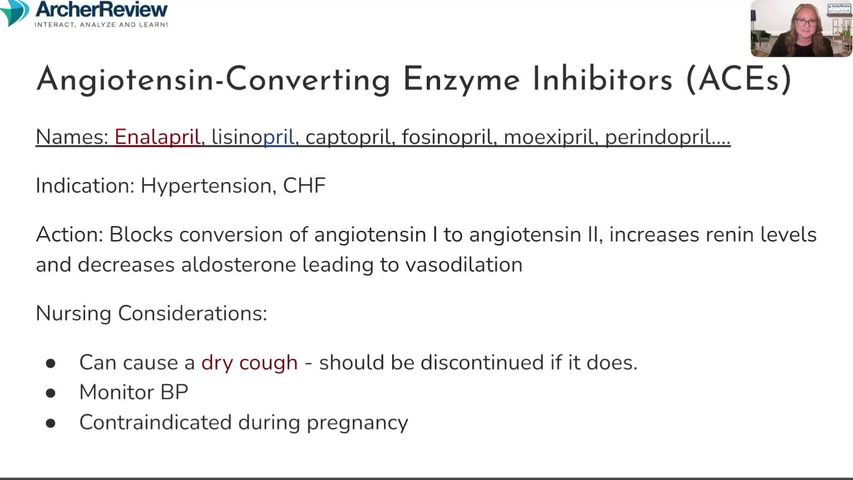
Choice A is incorrect. Nagging cough is a side effect associated with ACE inhibitors such as captopril. This is not found with calcium channel blockers.
Choice B is incorrect. Calcium channel blockers do not exert a diuretic effect. This would be an appropriate statement for a client taking a diuretic such as bumetanide or spironolactone.
Choice D is incorrect. Calcium channel blockers do not cause a depletion of potassium levels. It is not appropriate to recommend the client increase their dietary intake of potassium because it is unnecessary.
Related Videos
2 Key Topics
Antiarrhythmic Medications
6.4 Cardiovascular System Drugs
Additional Info
✓ Calcium channel blockers include diltiazem, verapamil, nifedipine, and amlodipine
✓ Indications for CCBs include migraine headache prevention, peripheral vascular disease, hypertension, preterm labor, and atrial fibrillation
✓ Diltiazem and verapamil require blood pressure and the pulse to be obtained before administration
✓ CCBs should not be administered for systolic heart failure because they have a negative inotropic effect, further reducing already limited cardiac output
https://app.archerreview.com/test-screen/MjQyNzUxNDE=/MTU3NTY=
