A nurse is educating a student nurse about blood transfusions. Which of the following statements by the student nurse indicates the need for additional teaching? Select all that apply.
A nurse is educating a student nurse about blood transfusions. Which of the following statements by the student nurse indicates the need for additional teaching? Select all that apply.
Statistics
Subject/Lesson
Subject
Pharmacology
Lesson
Blood and Blood Products
Client Need
Test Plan
Pharmacological and Parenteral Therapies
Related Topic
Blood and Blood Products
Item Type
Item Type
Analysis
Explanation
Choice A is correct. Crackles in the lung fields suggest a transfusion-associated circulatory overload (TACO). This statement requires correction because it is not correct.
Choice E is correct. Physicians may prescribe pre-medication with diphenhydramine and acetaminophen only if the client has a history of febrile or allergic reactions to prior blood transfusions. Pre-medications are, therefore, not always required.
Choice B is incorrect. Graft-versus-host-disease (GVHD) is a rare transfusion reaction that occurs mostly in severely immunocompromised clients (post-bone-marrow transplant, Hodgkin disease, non-Hodgkin lymphoma, and acute myeloid and acute lymphoid leukemias). In this condition, the donor's T lymphocytes cause an immune response in the recipient by engrafting in the recipient's marrow and attacking the recipient's tissues/blood cells. Under normal circumstances, donor T-cells are killed by the recipient's immune system, but in severe immunodeficiency, donor T-cells remain, causing GVHD. Transfusion-related GVHD presents with fever, rash all over, including feet and hands, diarrhea, nausea, and elevated Liver function tests. Such reactions can be limited by a process called “Cytoreduction,” where the T-cells are removed from the donor blood products.
Choice C is incorrect. Transfusion Associated Circulatory Overload (TACO) is more common in patients with baseline cardiac and renal disorders. Fluid overload can happen during transfusion if the client already has underlying congestive heart failure. If the client is felt to be at risk for circulatory overload, a loop diuretic such as furosemide may be ordered before, after, or in between PRBC units.
Choice D is incorrect. It is important to get a history of previous blood transfusions as the nurse can take action before the transfusion to pre-medicate the client, as prescribed.
Related Videos
2 Key Topics
Blood Administration
6.10 Hematology Drugs
Additional Info
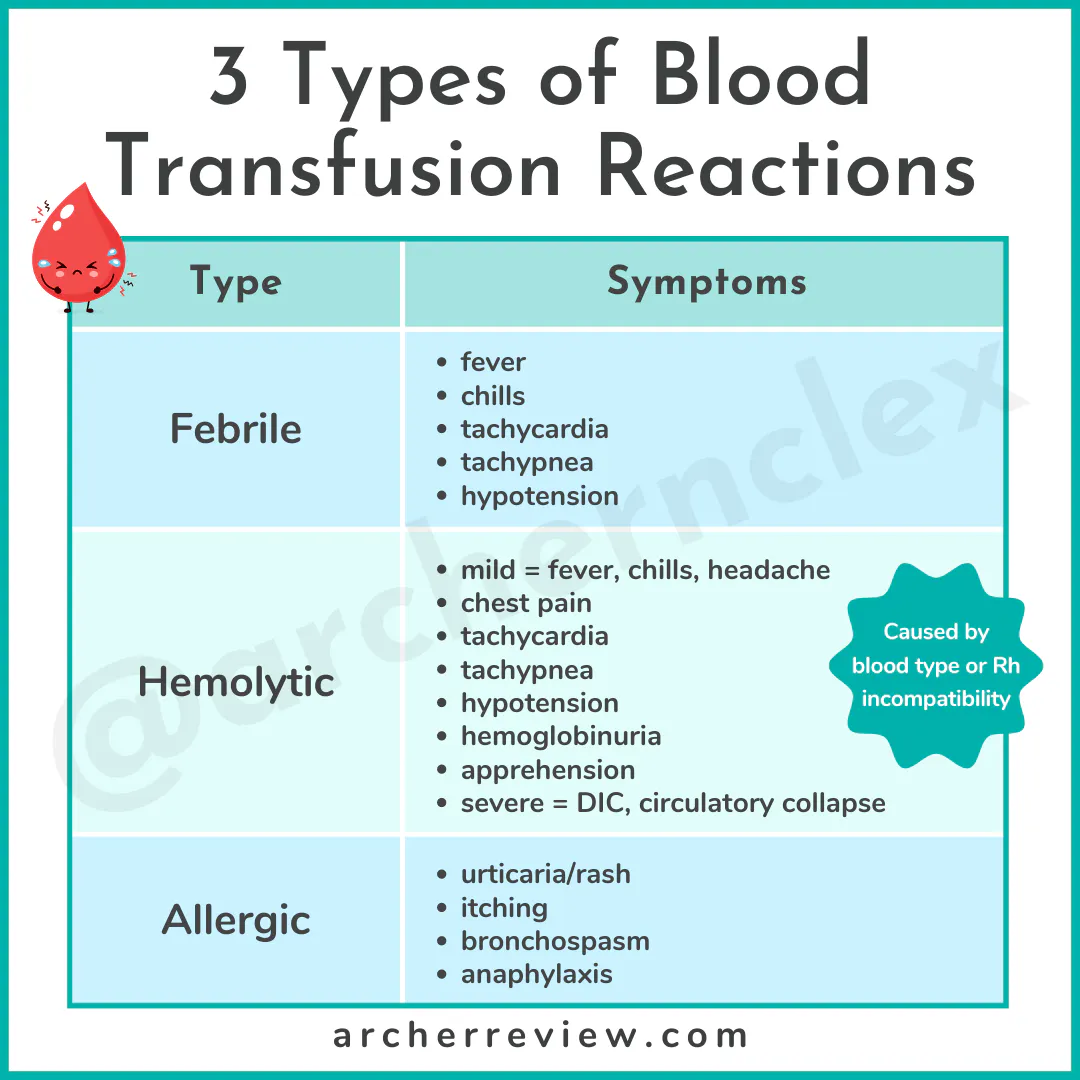
The nurse should remain with the client during a transfusion's first fifteen to thirty minutes to observe for a hemolytic or allergic reaction.
➢ A hemolytic blood transfusion may be fatal if not caught promptly. The primary cause of this reaction is the misidentification of the client and the blood product.
➢ Manifestations of a hemolytic reaction include low-back pain, chest pain, tachycardia, hypotension, and a feeling of impending doom.
➢ If a hemolytic reaction is assessed, the nurse should immediately discontinue the transfusion and save the tubing and unit of blood for further analysis.
➢ Immediate client care involves spiking a new bag of isotonic saline (with new tubing) and keeping the intravenous catheter patent.
