The nurse in the behavioral health unit is planning care for a client experiencing significant paranoia.
Which intervention would be the most effective for this client?
The nurse in the behavioral health unit is planning care for a client experiencing significant paranoia.
Which intervention would be the most effective for this client?
A. Plan to therapeutically respond to defense mechanisms
[19%]
B. Provide the client with a written schedule of activities
[8%]
C. Enroll the client in group therapy
[8%]
D. Maintain consistent caregivers
[65%]
Statistics
Subject/Lesson
Subject
Mental Health
Lesson
Mental Health
Client Need
Test Plan
Psychosocial Integrity
Related Topic
Sensory/Perceptual Alterations
Item Type
Item Type
Application
Explanation
Choice D is correct. This is the most effective intervention for a client experiencing significant paranoia. Consistent caregivers help reduce perceived threats, minimize misinterpretation of intent, and build trust, which are key components when addressing paranoia. It supports predictability and safety, which are essential in managing symptoms of paranoid thinking.
Choice A is incorrect. While understanding defense mechanisms is part of effective psychiatric care, this intervention doesn’t specifically address the core issue of paranoia (i.e., distrust and fear of harm).
Choice B is incorrect. Structure is important, but a written schedule may not be helpful to a paranoid client who might view written instructions as manipulative or controlling. This could increase suspicion rather than reduce it.
Choice C is incorrect. Group therapy may be overwhelming or threatening for a paranoid client early in treatment. Such clients often misinterpret others’ actions or conversations, making group settings counterproductive until trust is established.
Related Videos
2 Key Topics
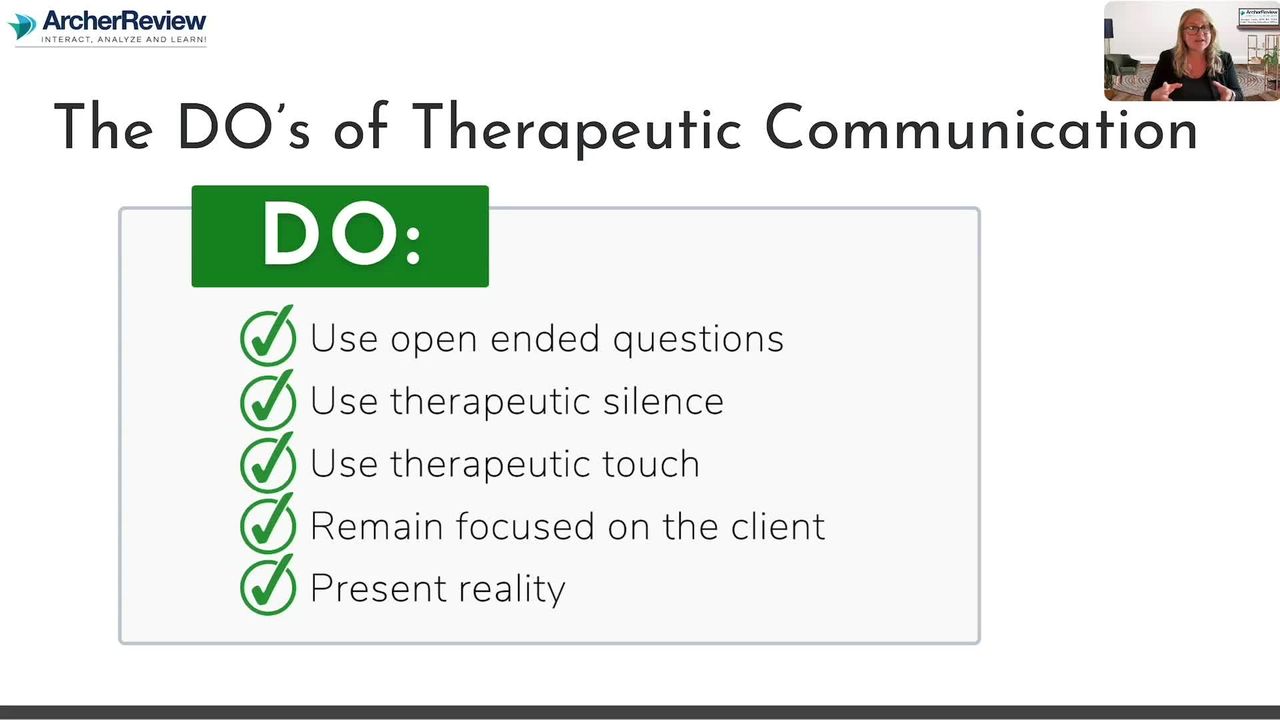
Therapeutic environment
13.3 Therapeutic Communication & Environment
Additional Info
✓ Individuals experiencing paranoia are often mistrustful and hostile towards others.
✓ Maintaining a neutral (and not overly warm) approach is recommended. Intense eye contact should be avoided.
✓ Consistent caregivers are recommended to help with rapport building.
✓ Initially, individual psychotherapy is recommended over group psychotherapy.
