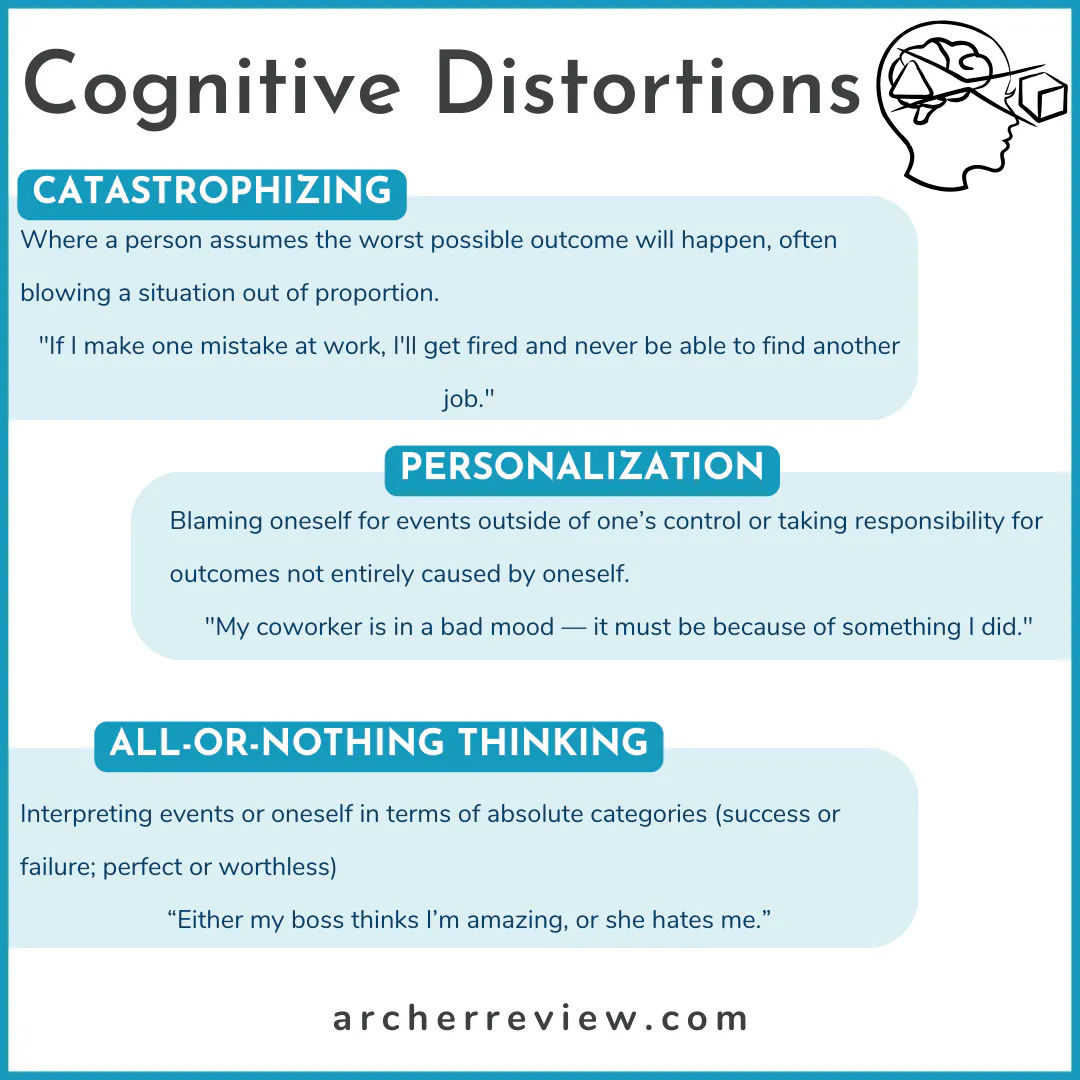
The nurse is interviewing a client who states, "If I make one mistake at work, I'll get fired and never be able to find another job."
The nurse recognizes that the client is demonstrating which cognitive distortion?
The nurse is interviewing a client who states, "If I make one mistake at work, I'll get fired and never be able to find another job."
The nurse recognizes that the client is demonstrating which cognitive distortion?
A. magnification or minimization
[18%]
B. emotional reasoning
[11%]
C. catastrophizing
[65%]
D. personalization
[7%]
Statistics
Subject/Lesson
Subject
Mental Health
Lesson
Mental Health
Client Need
Test Plan
Psychosocial Integrity
Related Topic
Coping Mechanisms
Item Type
Item Type
Analysis
Explanation
Choice C is correct. Catastrophizing is a cognitive distortion where a person assumes the worst possible outcome will happen, often blowing a situation out of proportion. In this case, the client believes that a single mistake at work will lead to being fired and never finding another job — an extreme and unlikely consequence reflecting catastrophic thinking.
Choice A is incorrect. Magnification involves exaggerating the importance or severity of events (e.g., viewing a small error as a disaster). Minimization involves downplaying or dismissing positive qualities or achievements. While the client is overreacting, the emphasis is not just on exaggerating the importance of a mistake, but specifically on projecting a disastrous chain of events (firing, permanent unemployment). That leap beyond simple magnification makes this better classified as catastrophizing rather than just magnification.
Choice B is incorrect. Emotional reasoning is assuming that because one feels something, it must be true, using emotions as evidence for facts (e.g., "I feel worthless, so I must be worthless.") The client is not expressing a feeling as truth (e.g., "I feel anxious, so I must be in danger"). Instead, they are expressing an irrational belief about future consequences, which better fits catastrophizing.
Choice D is incorrect. Personalization involves blaming oneself for events outside of one's control or taking responsibility for outcomes not entirely caused by oneself. (e.g., "My coworker is in a bad mood — it must be because of something I did."). The client is not taking responsibility for something beyond their control. Instead, they are reacting to a potential action (making a mistake) with an unrealistic and extreme prediction about the outcome, which aligns more closely with catastrophizing.
Related Videos
2 Key Topics
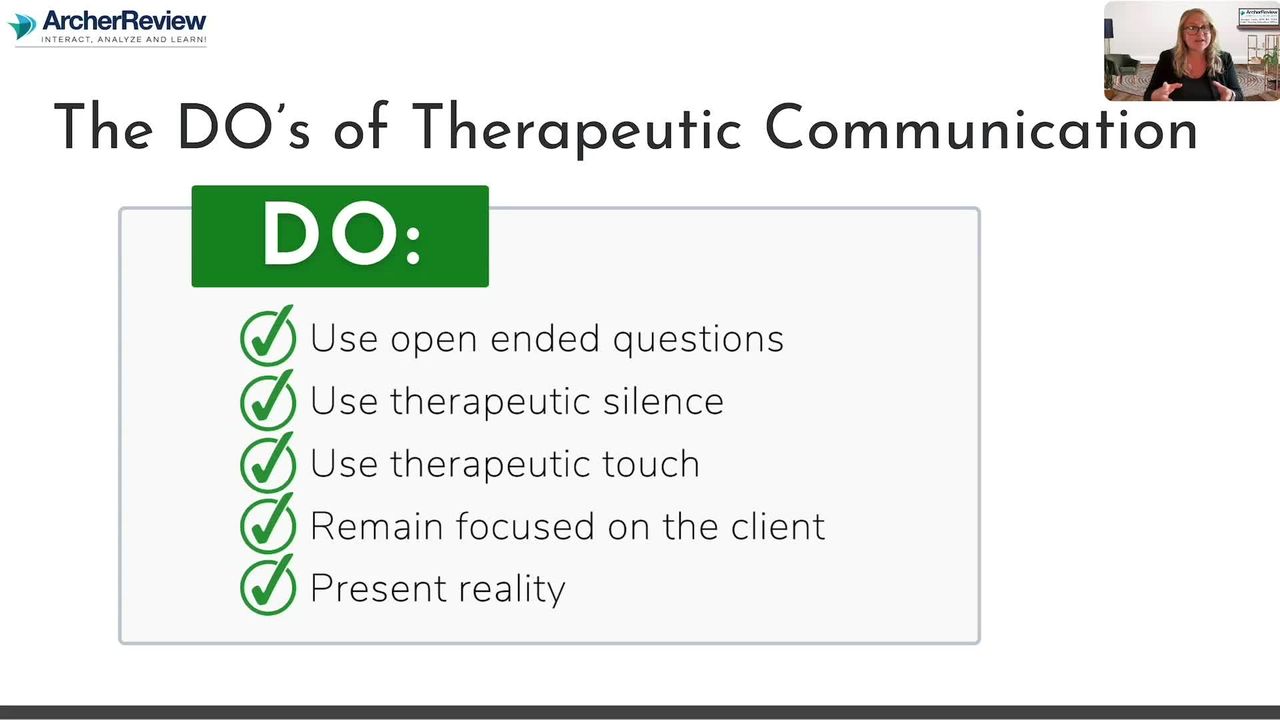
Therapeutic communication
13.3 Therapeutic Communication & Environment
Additional Info