A nurse prepares to transfer an involuntarily admitted client for ECT and notes the consent form is unsigned.
The nurse should understand that
A nurse prepares to transfer an involuntarily admitted client for ECT and notes the consent form is unsigned.
The nurse should understand that
A. informed consent should be obtained from the client's spouse.
[17%]
B. informed consent should be obtained from the client.
[55%]
C. informed consent is not required.
[11%]
D. informed consent needs to be obtained from the court.
[17%]
Statistics
Subject/Lesson
Subject
Mental Health
Lesson
Mental Health
Client Need
Test Plan
Management of Care
Related Topic
Informed Consent
Item Type
Item Type
Application
Explanation
Choice B is correct. Even though the client is involuntarily admitted, the client does not lose the right to provide, withhold, and/or withdraw any previously provided informed consent (if applicable). Informed consent for electroconvulsive therapy (ECT) must be obtained from the client voluntarily, regardless of the client's involuntary admission status.
Choice A is incorrect. Unless the client's spouse has the legal authority to consent on the client's behalf through a court of law, the client's spouse cannot provide consent for the client to undergo electroconvulsive therapy (ECT).
Choice C is incorrect. Electroconvulsive therapy (ECT) requires informed consent from the client prior to proceeding with the procedure, regardless of the client's involuntary admission status. Performing this procedure on this non-consenting (or any other non-consenting) client potentially places the healthcare workers involved at risk of legal implications, including, but not limited to, criminal and/or civil liability.
Choice D is incorrect. Informed consent does not need to be obtained from the court. Based on the information contained within the question, the client continues to retain autonomy to provide, withhold, and/or withdraw any previously provided informed consent (if applicable). Here, the court is not in a position to provide informed consent in place of the client.
Learning Objective
While caring for an involuntarily admitted client with an order for electroconvulsive therapy (ECT) and an unsigned consent form, the nurse should understand that informed consent can only be obtained from the client.
Related Videos
2 Key Topics

Electroconvulsive Therapy
32.1 Psychopharmacology (Medications & Treatments)
Additional Info
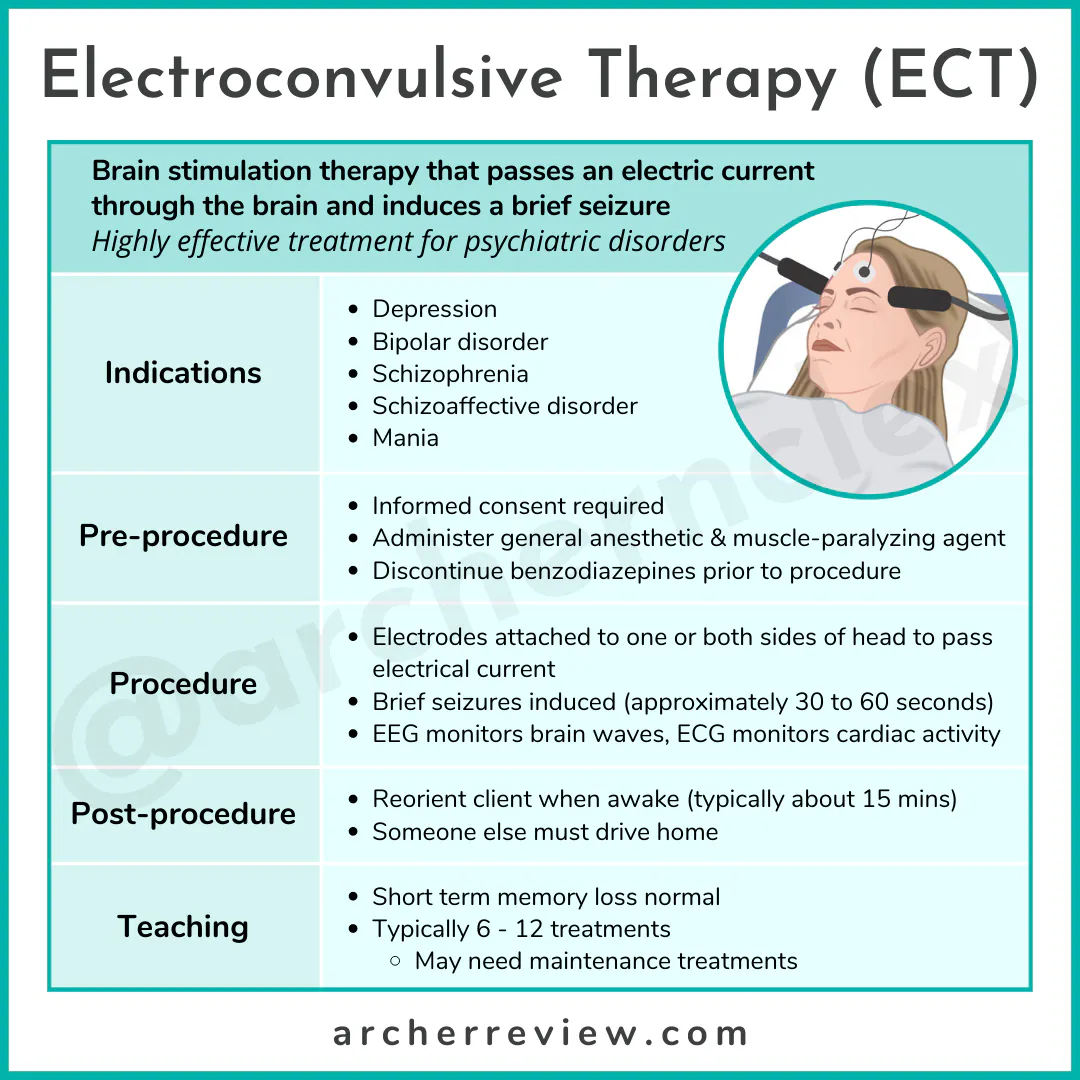 Source : Source: Archer Review
✓ When a client is admitted involuntarily, the only client right that is waived is the right to leave the treatment facility.
✓ Even when involuntarily admitted, the client retains the right to receive the basic information regarding risks, benefits, and alternatives to any proposed treatment, procedure, and/or medication; with the client subsequently deciding whether to consent or refuse the proposed treatment, procedure, and/or medication.
✓ Many U.S. jurisdictions regard electroconvulsive therapy (ECT) differently from other interventions with comparable risks and potential benefits, contrary to the American Psychiatric Association's (APA) recommendations.
✓ Informed consent is part of the healthcare provider-client relationship.
✓ In most situations, obtaining the client's informed consent does not fall within the nurse's responsibility, although verifying the signed informed consent is contained within the chart is a nursing responsibility.
✓ The health care provider (HCP) responsible for performing the procedure is the individual responsible for obtaining informed consent.
