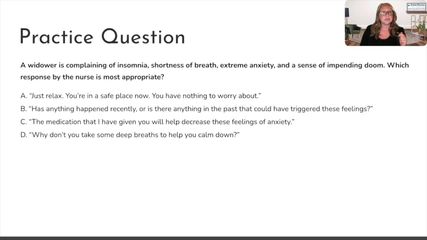
The nurse is talking with a widower who is complaining of insomnia, shortness of breath, extreme anxiety, and a sense of impending doom. Which response by the nurse is most appropriate?
The nurse is talking with a widower who is complaining of insomnia, shortness of breath, extreme anxiety, and a sense of impending doom. Which response by the nurse is most appropriate?
A. “Just relax. You’re in a safe place now. You have nothing to worry about.”
[5%]
B. “Has anything happened recently, or is there anything in the past that could have triggered these feelings?”
[81%]
C. “The medication that I have given you will help decrease these feelings of anxiety.”
[5%]
D. “Why don’t you take some deep breaths to help you calm down?”
[9%]
Statistics
Subject/Lesson
Subject
Mental Health
Lesson
Mental Health
Client Need
Test Plan
Psychosocial Integrity
Related Topic
Therapeutic Communication
Item Type
Item Type
Application
Explanation
Choice B is correct. Of the available options this is the best choice. While it's important to approach the situation with sensitivity, this response still allows for the exploration of potential triggers, but it does so in a more open-ended and non-confrontational manner. It invites the individual to share if they are comfortable doing so, while also acknowledging the possibility of past experiences contributing to their current distress. This response promotes open communication and understanding without placing undue pressure on the individual during their moment of distress.
Choice A is incorrect. Telling the client he has nothing to worry about dismisses the client's feelings and only gives him false reassurance. By indicating to the client that there is no cause for anxiety, the nurse is thereby devaluing the client's feelings. By doing so, the nurse may inadvertently discourage the client from further verbalizing their feelings, as the client believes they will only be subsequently downplayed or ridiculed.
Choice C is incorrect. Simply medicating a client and instructing them to calm down doesn't allow the client to verbalize their feelings, which is necessary for both the client and the treating health care provider (HCP) to understand and ultimately use to resolve the underlying cause of the anxiety.
Choice D is incorrect. Telling the client to take some deep breaths to help calm down implies that the nurse knows what is best and that the client is incapable of any self-direction. This type of nontherapeutic communication nurtures the client into a dependent role by discouraging independent thinking and should therefore be avoided.
Learning Objective
When caring for a client experiencing extreme anxiety, identify the most appropriate response by the nurse as the response which reassures the client while providing an opportunity to gain insight into the root of the client's anxiety.
Related Videos
6 Key Topics
Open-Ended Questions
13.10 Therapeutic Communication
Never Ask Why
13.10 Therapeutic Communication
Never Dismiss Feelings
13.10 Therapeutic Communication
Additional Info
✓ Therapeutic communication has demonstrated multiple clinical benefits, including improved client satisfaction, primarily by fulfilling the client's expectations and values during each encounter.
✓ Each healthcare team member plays a vital role in therapeutic communication with the client.
✓ Each team member gathers information from and subsequently communicates information to the client in various contexts.
✓ Be culturally sensitive and aware of how different cultural backgrounds may influence a person's response to distress and their preferences for coping strategies.
