The nurse is caring for a client with anorexia nervosa, binge-eating/purging subtype.
Which action should the nurse plan to take following the client’s meals?
The nurse is caring for a client with anorexia nervosa, binge-eating/purging subtype.
Which action should the nurse plan to take following the client’s meals?
A. Instruct the client to go for a walk after meals.
[15%]
B. Restrict the client from using the restroom for one hour following meals.
[67%]
C. Ask the client to lie down for two hours after each meal.
[14%]
D. Provide the client with additional liquids following each meal.
[4%]
Statistics
Subject/Lesson
Subject
Mental Health
Lesson
Mental Health
Client Need
Test Plan
Psychosocial Integrity
Related Topic
Mental Health Concepts
Item Type
Item Type
Analysis
Explanation
Choice B is correct. Clients with the binge-purge subtype of anorexia nervosa often engage in purging behaviors such as self-induced vomiting after meals. Restricting access to the restroom for a period following meals is a common strategy used in treatment settings to prevent these behaviors and promote accountability during the recovery process. This helps the care team monitor for purging and support healthier coping mechanisms.
Choice A is incorrect. While light movement may be appropriate in some populations for digestion, this is not appropriate for someone with an eating disorder, particularly those with compensatory behaviors like purging or excessive exercise. Clients with anorexia nervosa may misuse "walking" as a form of covert exercise to burn calories or control anxiety about eating.
Choice C is incorrect. Lying down after meals may cause physical discomfort (e.g., reflux) and does not address disordered eating behaviors. It may also contribute to feelings of guilt or rumination. Therapeutic interventions after meals typically focus on structured observation, engagement in distraction techniques (e.g., journaling, group activities), or therapeutic conversation, not physical inactivity in a prone position, which may foster isolation or emotional distress.
Choice D is incorrect. Although hydration is important, encouraging excessive fluid intake immediately after meals is risky in clients with eating disorders. It can be used as a method to induce vomiting, manipulate weight (e.g., "water loading" before weigh-ins), or produce early satiety. Any fluid intake should be supervised and clinically appropriate, not routinely encouraged post-meal without a specific reason.
Learning Objective
When caring for a client with anorexia nervosa, recognize the need to restrict the client from using the restroom for 90 minutes following each meal.
Related Videos
2 Key Topics
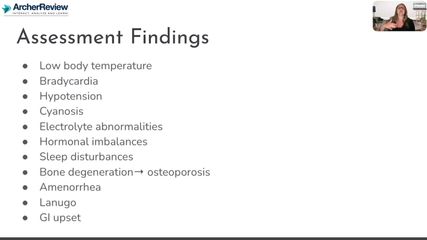
Anorexia Nervosa
32.4 Eating Disorders
Additional Info
✓ Anorexia nervosa occurs predominantly in girls and young women.
✓ The onset of this disease usually occurs during adolescence and rarely occurs after age forty.
✓ Two types of anorexia nervosa are recognized:
- In the restricting type of anorexia nervosa, clients restrict food intake but do not regularly engage in binge eating or purging behavior. Additionally, some of these clients exercise excessively.
- In those with the binge eating/purging type of anorexia nervosa, clients regularly binge eat before inducing vomiting and/or misusing laxatives, diuretics, or enemas. Unlike bulimia clients (who are of normal or above-normal weight), these clients have a significantly low body weight.
✓ Clients with anorexia nervosa have an intense fear of gaining weight or becoming fat that persists despite all evidence to the contrary. In adults, BMI is significantly low (usually BMI of < 17 kg/m2), and in adolescents, BMI percentile is low (usually < 5th percentile) or does not increase as expected for normal growth.
✓ Endocrine or electrolyte abnormalities or cardiac arrhythmias may develop, potentially resulting in death.
✓ Treatment consists of nutritional supplementation and psychotherapy (e.g., cognitive behavioral therapy). For adolescents, family-based therapy is often utilized.
