A nurse is caring for a client who delivered vaginally 2 hours ago.
Which of the following findings requires the nurse’s immediate attention?
A nurse is caring for a client who delivered vaginally 2 hours ago.
Which of the following findings requires the nurse’s immediate attention?
A. saturating one perineal pad in 2 hours
[9%]
B. temperature of 100.4°F (38°C
[20%]
C. fundus palpable 2 cm above the umbilicus and deviated to the right
[65%]
D. small clots expressed during fundal massage
[6%]
Statistics
Subject/Lesson
Subject
Maternal & Newborn Health
Lesson
Postpartum
Client Need
Test Plan
Management of Care
Related Topic
Collaboration with Interdisciplinary Team
Item Type
Item Type
Application
Explanation
Choice C is correct. A fundus that is elevated and deviated to the right suggests a distended bladder, which can interfere with uterine contraction and increase the risk of postpartum hemorrhage. This requires immediate nursing intervention—usually assisting the client to void—to promote uterine involution and prevent bleeding.
Choice A is incorrect. Saturating one perineal pad in 2 hours is within the normal range for early postpartum bleeding (expected is ≤1 pad per hour). No immediate action is needed unless bleeding increases.
Choice B is incorrect. A temperature of 100.4°F (38°C) in the first 24 hours postpartum can be a normal finding due to dehydration and the inflammatory response associated with labor. It should be monitored, but is not emergent.
Choice D is incorrect. Small clots during fundal massage may be expected as the uterus contracts and expels remaining products of conception. Large clots (>golf-ball size) would be more concerning.
Learning Objective
Prioritize postpartum assessment findings that require immediate intervention to prevent maternal complications such as hemorrhage.
Related Videos
2 Key Topics
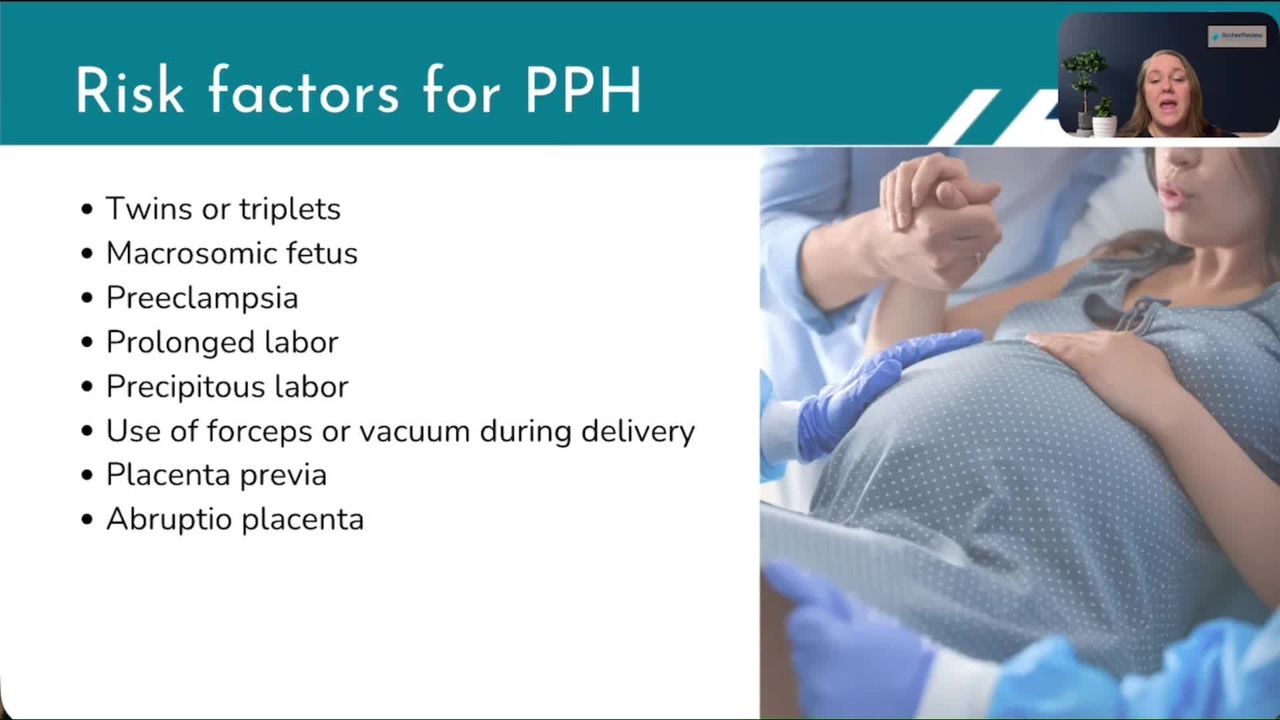
Postpartum Hemorrhage
30.5 Postpartum Complications & Mental Health
Additional Info
✓ After delivery, the uterus should be firm, midline, and near or below the umbilicus. A displaced or boggy uterus increases hemorrhage risk.
✓ A full bladder can displace the uterus and prevent effective contractions.
✓ Early recognition and intervention (like assisting with voiding) can prevent complications such as uterine atony and hemorrhage.
✓ Postpartum assessments focus on the "BUBBLE-LE" framework (Breasts, Uterus, Bladder, Bowels, Lochia, Episiotomy, Legs, Emotional status).
