Which of the following does the Apgar scoring system indicate?
Which of the following does the Apgar scoring system indicate?
A. Heart rate, cyanosis, and edema
[1%]
B. Heart rate, seizure activity, respiratory effort
[1%]
C. Irritability, heart rate, respiratory effort, muscle tone, and color
[97%]
D. Reflex, respiratory rate, and bleeding
[1%]
Statistics
Subject/Lesson
Subject
Maternal & Newborn Health
Lesson
Newborn
Client Need
Test Plan
Health Promotion and Maintenance
Related Topic
Ante/Intra/Postpartum and Newborn Care
Item Type
Item Type
Knowledge/Comprehension
Explanation
Choice C is correct. The APGAR score is a systematic method of assessing a newborn’s physical condition at birth. It is used to determine the newborn’s heart rate, muscle tone, response to stimuli, and color rating by assigning a score of 0 to 2 for each category. The newborn is assessed 1 minute after birth and again at 5 minutes after birth. A score between 7 and 10 indicates that the newborn is adjusting to extrauterine life. A score below 7 indicates that medical or nursing interventions may be needed to improve the newborn’s cardiorespiratory status. If the 5 minute APGAR score is below 7, the newborn should be assessed every 5 minutes until the count is 7 or higher.
Choice A is incorrect. Assessment for edema is not part of the APGAR scoring system.
Choice B is incorrect. Seizure activity is not part of the APGAR scoring system.
Choice D is incorrect. Bleeding assessment is not part of the APGAR scoring system.
NCSBN Client Need Topic: Safe and Effective Care Environment, Subtopic: Safety and Infection Control, APGAR Score
Related Videos
2 Key Topics
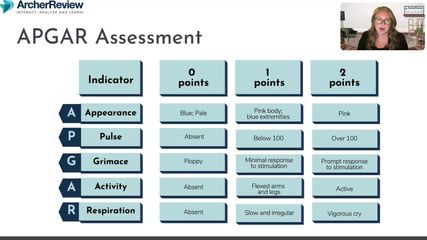
APGAR
