The nurse is assessing a newborn client.
Which of the following best describes the expected circulatory adaptation in a newborn immediately after birth?
The nurse is assessing a newborn client.
Which of the following best describes the expected circulatory adaptation in a newborn immediately after birth?
A. Closure of the ductus arteriosus due to decreased pulmonary pressure
[51%]
B. Increased blood flow through the foramen ovale
[16%]
C. Maintenance of placental circulation to aid in oxygenation
[14%]
D. Decreased systemic vascular resistance due to placental removal
[19%]
Statistics
Subject/Lesson
Subject
Maternal & Newborn Health
Lesson
Newborn
Client Need
Test Plan
Health Promotion and Maintenance
Related Topic
Ante/Intra/Postpartum and Newborn Care
Item Type
Item Type
Analysis
Explanation
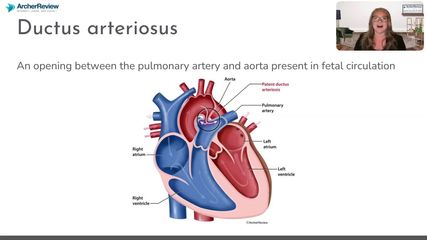
Choice A is correct. After birth, the baby’s first breaths expand the lungs, reducing pulmonary vascular resistance and increasing blood flow to the lungs. Increased oxygen levels and decreased prostaglandins lead to functional closure of the ductus arteriosus within the first hours to days of life.
Choice B is incorrect. The foramen ovale functionally closes as left atrial pressure exceeds right atrial pressure due to increased pulmonary blood flow. Blood does not continue to flow through the foramen ovale after birth under normal conditions.
Choice C is incorrect. The placental circulation ceases when the umbilical cord is clamped. Oxygenation is now the responsibility of the newborn’s own lungs, not the placenta.
Choice D is incorrect. Systemic vascular resistance increases after birth due to the removal of the low-resistance placental circulation. This change is essential to redistribute blood flow to vital organs.
Learning Objective
Explain the physiological circulatory changes that occur during the transition from intrauterine to extrauterine life.
Related Videos
2 Key Topics
Fetal Circulation
31.3 Fetal Circulation and Congenital Heart Defect Overview
Additional Info
✓ Fetal circulation includes three shunts: foramen ovale, ductus arteriosus, and ductus venosus.
✓ At birth, the infant’s lungs expand, reducing pulmonary vascular resistance and increasing blood flow to the lungs.
✓ Functional closure of the foramen ovale and ductus arteriosus is triggered by increased oxygenation and changes in pressure gradients.
✓ Clamping the umbilical cord increases systemic vascular resistance and ends placental circulation.
✓ Failure of fetal shunt closure may result in conditions like PDA (patent ductus arteriosus) or PFC (persistent fetal circulation) requiring medical intervention.
