The nurse reviews a client's antepartum nonstress test results as reactive.
The nurse interprets this finding as
The nurse reviews a client's antepartum nonstress test results as reactive.
The nurse interprets this finding as
A. fetal heart rate accelerations less than 15 beats per minute or lasting less than 15 seconds.
[32%]
B. no late decelerations of the fetal heart rate.
[18%]
C. late decelerations are present with a minimum of 50% of the contractions.
[10%]
D. two or more fetal heart rate accelerations within a 20-minute period.
[40%]
Statistics
Subject/Lesson
Subject
Maternal & Newborn Health
Lesson
Antepartum
Client Need
Test Plan
Health Promotion and Maintenance
Related Topic
Ante/Intra/Postpartum and Newborn Care
Item Type
Item Type
Analysis
Explanation
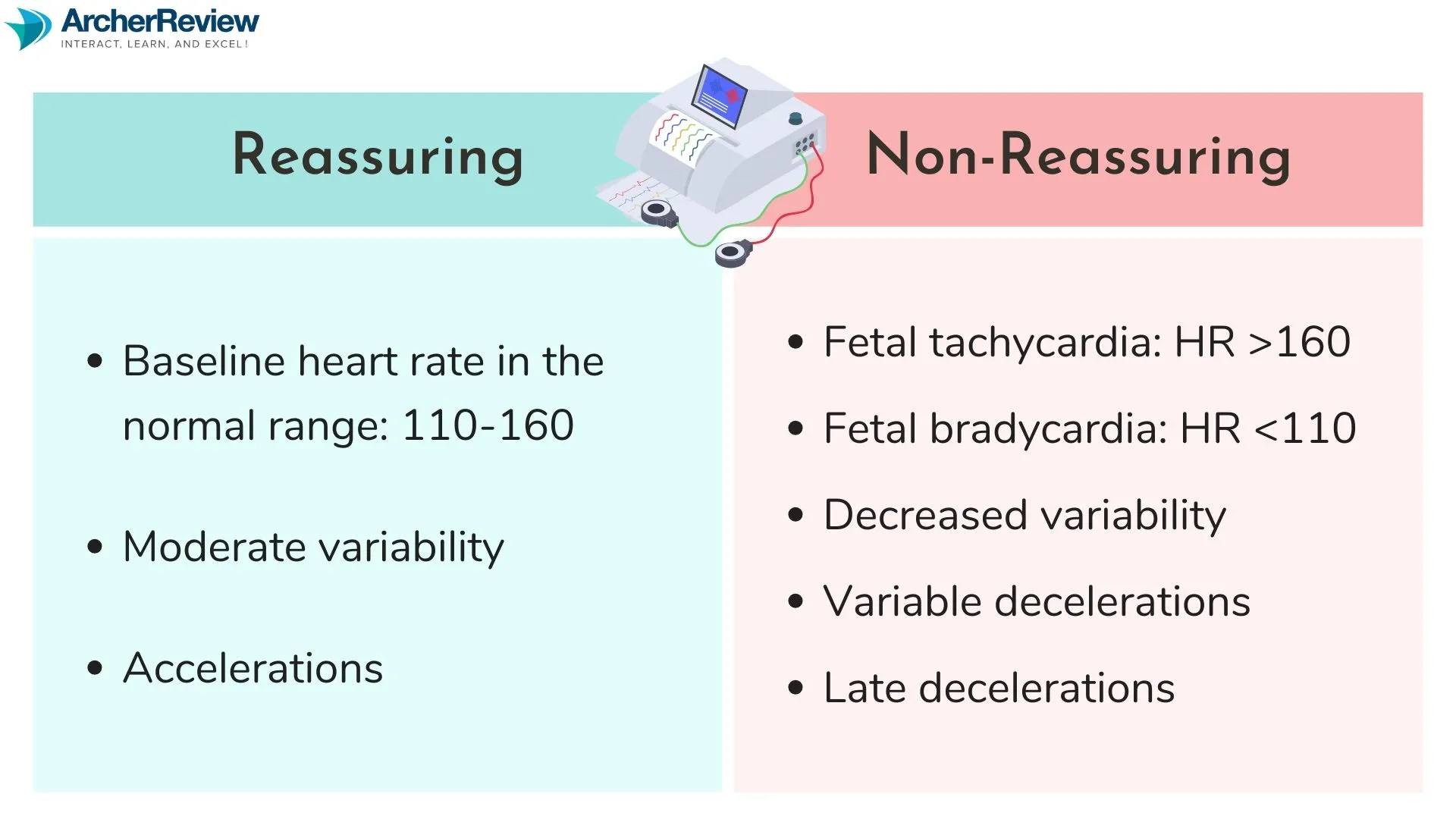
Choice D is correct. A reactive nonstress test indicates a normal result. In this finding, two or more fetal heart rate accelerations within a 20-minute period were observed. These accelerations should also be at least 15 beats per minute (bpm) and last longer than 15 seconds.
Choice A is incorrect. This is a nonreactive test result, which is concerning. A nonreactive test result is defined as fewer than two accelerations during a 20-minute period. The accelerations for a reactive NST should be at least 15 bpm lasting for longer than 15 seconds.
Choice B is incorrect. No late fetal heart rate decelerations are consistent with a negative contraction stress test (CST). A negative CST is a reassuring finding.
Choice C is incorrect. Late decelerations present in a minimum of 50% of the contractions are a positive CST. A positive CST is not a reassuring finding and is considered an abnormal result.
Related Videos
2 Key Topics
Nonstress Test
29.3 Fetal Assessment Tests
Additional Info
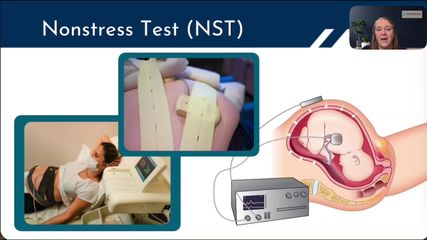
✓ A fetal non-stress test (NST) is a prenatal test performed to evaluate the fetus's well-being.
✓ The test is typically recommended when there is a concern about fetal health, such as a high-risk pregnancy, decreased fetal movement, or other pregnancy complications.
✓ The test determines whether the placenta appropriately exchanges oxygen, carbon dioxide, nutrients, and waste products between maternal and fetal circulation.
✓ If there are no accelerations or the fetal heart rate is abnormal, further testing or interventions may be recommended to ensure the health and safety of the fetus.