The nurse is performing a cardiovascular assessment on a client.
Which cardiovascular mechanism is primarily responsible for generating the first heart sound (S1)?
The nurse is performing a cardiovascular assessment on a client.
Which cardiovascular mechanism is primarily responsible for generating the first heart sound (S1)?
A. Opening of the mitral and tricuspid valves
[31%]
B. Closure of the mitral and tricuspid valves
[39%]
C. Opening of the aortic and pulmonic valves
[23%]
D. Closure of the aortic and pulmonic valves
[7%]
Statistics
Subject/Lesson
Subject
Fundamentals
Lesson
Skills/Procedures
Client Need
Test Plan
Health Promotion and Maintenance
Related Topic
Techniques of Physical Assessment
Item Type
Item Type
Knowledge/Comprehension
Explanation
Choice B is correct. The first heart sound (S1) is produced by the closure of the atrioventricular (AV) valves—the mitral and tricuspid valves—at the beginning of ventricular systole. This marks the end of diastole and the start of the heart’s pumping phase.
Choice A is incorrect. This occurs during early diastole and does not generate a distinct heart sound under normal circumstances.
Choice C is incorrect. These valves open during systole but do not produce S1; instead, they are associated with blood ejection.
Choice D is incorrect. This produces the second heart sound (S2), not S1. S2 occurs at the end of systole and marks the beginning of diastole.
Related Videos
4 Key Topics
Cardiovascular Anatomy & Physiology
18.1 Cardiovascular Anatomy & Physiology

Cardiovascular Assessment
14.6 Integumentary & System-Focused Assessment
Additional Info
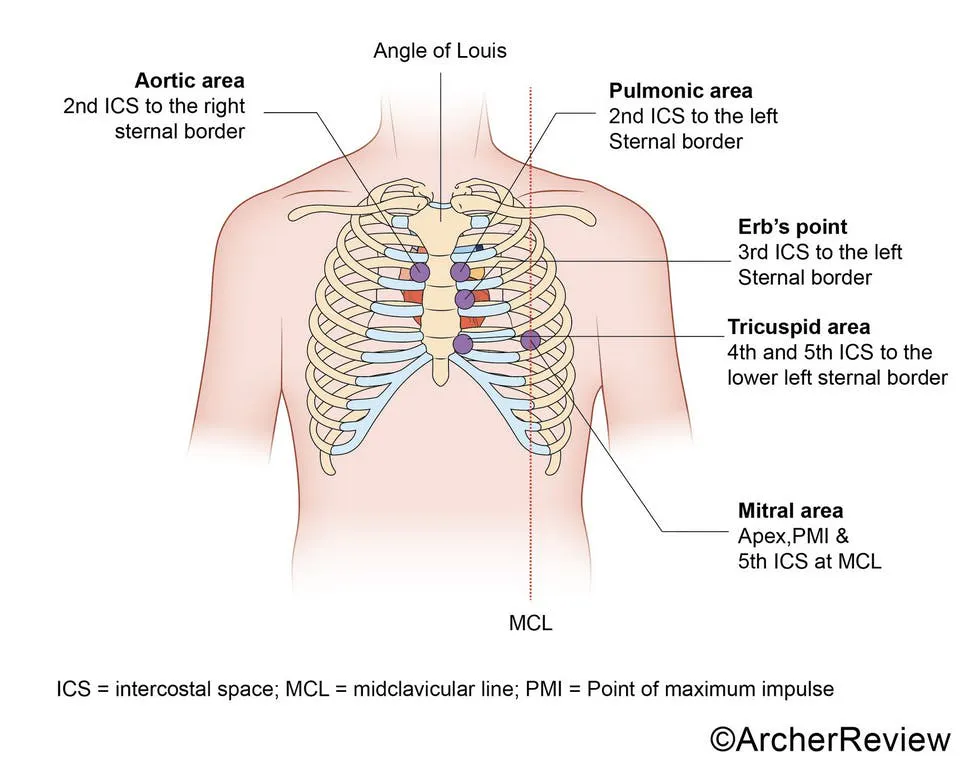
✓ S1 is caused by the closure of the mitral and tricuspid valves at the beginning of ventricular systole (isovolumetric contraction phase), marking the onset of the heartbeat and best heard at the apex of the heart.
✓ S2 is produced by the closure of the aortic and pulmonic valves at the end of systole (isovolumetric relaxation phase), marking the beginning of diastole and is best auscultated at the base of the heart (second intercostal space, left and right sternal borders).
✓ S1 is typically louder than S2 at the apex, while S2 is louder at the base.
https://app.archerreview.com/test-screen/MjQzMzczNDk=/MzE5NTA=
