The nurse is preparing a client for the insertion of a subclavian central vascular access device. To reduce the client's risk for an air embolism, the nurse places the client in which position? See the images below.
The nurse is preparing a client for the insertion of a subclavian central vascular access device. To reduce the client's risk for an air embolism, the nurse places the client in which position? See the images below.
Statistics
Subject/Lesson
Subject
Critical Care
Lesson
Critical Care Concepts
Client Need
Test Plan
Reduction of Risk Potential
Related Topic
Potential for Complications of Diagnostic Tests/Treatments/Procedures
Item Type
Item Type
Analysis
Explanation
Choice C is correct. This image shows the Trendelenburg position. In this position, the body is supine, or flat on the back, on a 15-30 degree incline, with the feet elevated above the head. This position is used to prevent air embolism during central venous cannulation. When placing and removing central venous catheters, the CVP should be raised (to decrease the pressure gradient) by placing the patient in the Trendelenburg position. It should also be ensured that patients are adequately hydrated to prevent hypovolemia and increase CVP. The Trendelenburg position is also used to increase the venous blood return to the heart when a client is affected with hypotension, hypovolemia, or shock.
Choice A is incorrect. This image represents a supine position. This position would be used immediately following a renal biopsy to prevent bleeding. This position is not used for preparing a client for the insertion of a central vascular access device.
Choice B is incorrect. This image represents a prone position. This position would be used for a kidney ultrasound or biopsy. This position is not used for preparing a client for the insertion of a central vascular access device.
Choice D is incorrect. This image represents a Fowler's position in which the head of the bed is elevated to a 45 - 60 degrees angle. This position is not used for preparing a client for the insertion of a central vascular access device.
Related Videos
2 Key Topics
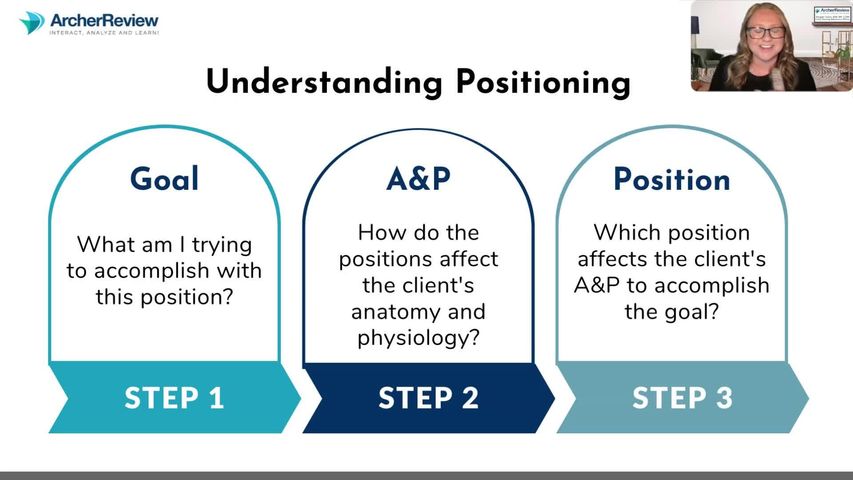
Disease Specific Positioning
9.14 Disease-Specific Positioning
Additional Info
✓ In cases of venous air embolism, position the client in the left lateral decubitus and Trendelenburg position.
✓ This encourages the air bubble to move out of the right ventricular outflow tract (RVOT) and into the right atrium, thereby relieving the "air-lock” effect responsible for the potentially catastrophic cardiopulmonary collapse. ✓ It is important to note that, in the case of arterial air embolism, clients should be kept in the flat supine position as the head-down position may worsen cerebral edema
