The nurse in the intensive care unit (ICU) is caring for a client who has experienced multiple ventricular dysrhythmias in the past 24 hours.
The nurse recognizes that if the client develops ventricular fibrillation, the priority treatment is
The nurse in the intensive care unit (ICU) is caring for a client who has experienced multiple ventricular dysrhythmias in the past 24 hours.
The nurse recognizes that if the client develops ventricular fibrillation, the priority treatment is
A. cardiopulmonary resuscitation (CPR).
[11%]
B. intravenous epinephrine.
[8%]
C. defibrillation.
[79%]
D. rapid isotonic fluid resuscitation.
[2%]
Statistics
Subject/Lesson
Subject
Critical Care
Lesson
Critical Care Concepts
Client Need
Test Plan
Physiological Adaptation
Related Topic
Medical Emergencies
Item Type
Item Type
Application
Explanation
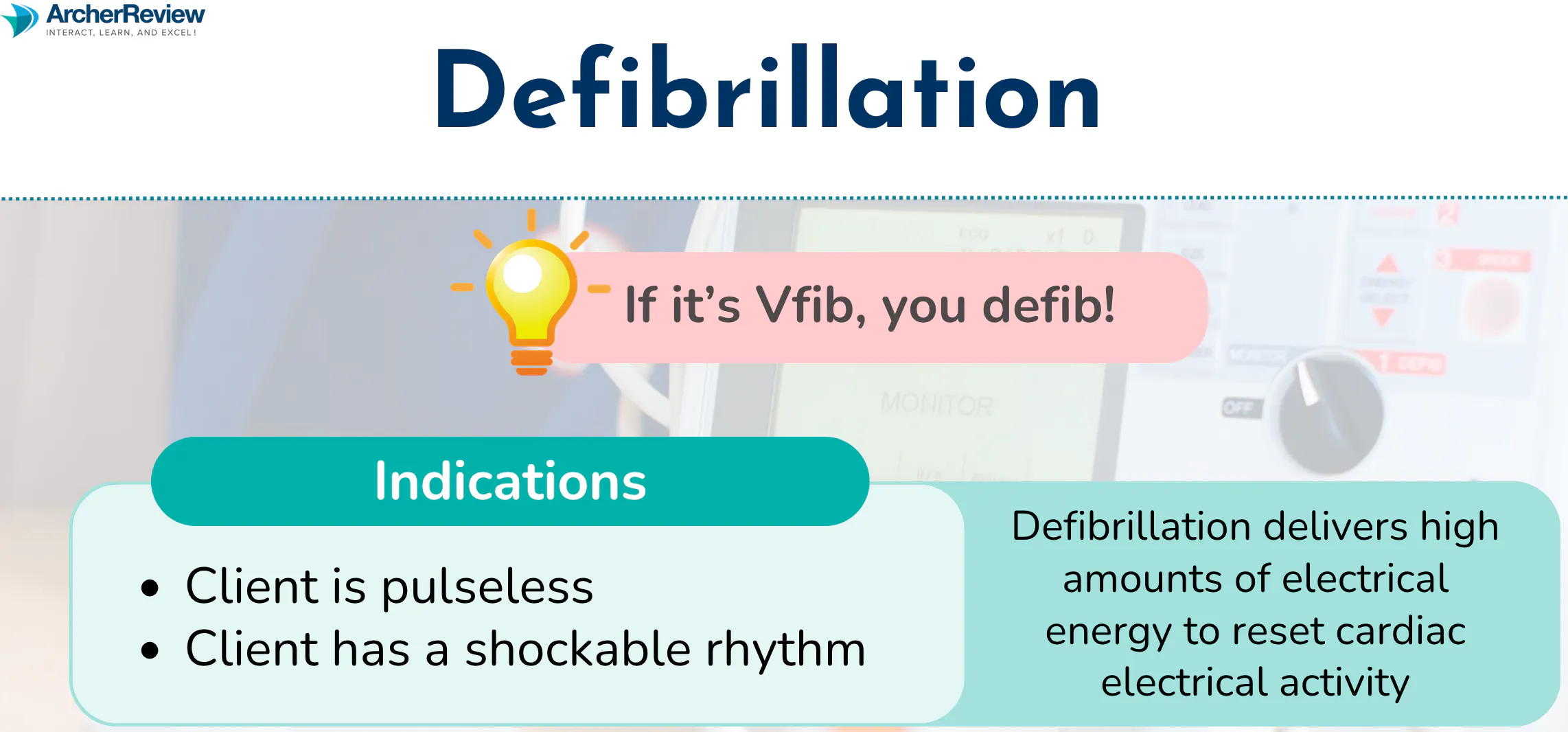
Choice C is correct. Defibrillation is the priority intervention for ventricular fibrillation (VF), a life-threatening arrhythmia in which the ventricles quiver ineffectively, producing no cardiac output. Immediate defibrillation is required to restore an organized rhythm and circulation. While high-quality CPR is essential to maintain limited perfusion to the brain and heart until defibrillation can be performed, it does not stop VF or restore a viable rhythm.
Choice A is incorrect. While CPR is initiated immediately if a defibrillator is not available, defibrillation remains the first-line treatment for VF. CPR supports circulation until defibrillation can be performed, but it is not a substitute for it.
Choice B is incorrect. Epinephrine is part of the advanced cardiac life support (ACLS) algorithm after initial defibrillation and CPR, but it is not the initial or priority treatment for VF.
Choice D is incorrect. This intervention is appropriate for hypovolemia or hypotension, not for arrhythmias like VF. It does not address the underlying electrical chaos in the heart seen in VF.
Related Videos
2 Key Topics
Ventricular Fibrillation
7.6 Ventricular Dysrhythmias & Cardiac Arrest
Additional Info