The nurse is caring for a client with severe sepsis admitted to the critical care unit.
Which of the following interventions should the nurse prioritize during the initial management of sepsis?
The nurse is caring for a client with severe sepsis admitted to the critical care unit.
Which of the following interventions should the nurse prioritize during the initial management of sepsis?
A. administer prescribed broad-spectrum antibiotics
[72%]
B. initiate invasive hemodynamic monitoring
[22%]
C. administer pain medication to keep the client comfortable
[3%]
D. administer prescribed corticosteroids
[2%]
Statistics
Subject/Lesson
Subject
Critical Care
Lesson
Critical Care Concepts
Client Need
Test Plan
Physiological Adaptation
Related Topic
Alterations in Body Systems
Item Type
Item Type
Application
Explanation
Choice A is correct. Sepsis is a life-threatening condition caused by a systemic reaction to an infection. Prompt administration of appropriate antibiotics is crucial in the management of sepsis to target the underlying infectious source and prevent further progression. Early initiation of broad-spectrum antibiotics is the priority before specific culture and sensitivity results are available. Broad-spectrum antibiotics would be given after appropriate cultures have been obtained.
Choice B is incorrect. In some cases, invasive hemodynamic monitoring may be necessary to guide fluid and vasopressor therapy but is not the highest priority during the initial management of sepsis. There is not enough information in the question to support this answer.
Choice C is incorrect. While managing the client's pain is important for overall care, pain medication is not the priority in the initial management of severe sepsis. Addressing the underlying infection and preventing further deterioration take precedence.
Choice D is incorrect. Administering corticosteroids may be considered in select cases of septic shock with adrenal insufficiency. Still, it is not a first-line intervention and is not universally indicated in all cases of sepsis. There is not enough information in the question to support this answer.
Related Videos
2 Key Topics
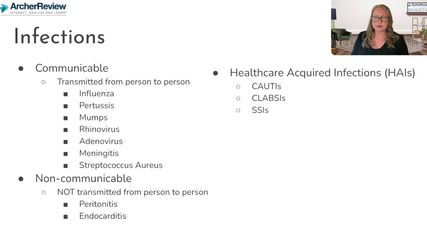
Sepsis
23.3 Infection Control & Infectious Diseases
Additional Info
✓ Sepsis is life-threatening organ dysfunction brought on by a dysregulated response to infection
✓ Common antibiotics used in sepsis include vancomycin, azithromycin, doxycycline, and ceftriaxone
✓ If untreated, the client could progress to septic shock. Septic shock is a subset of sepsis in which circulatory, cellular, and metabolic alterations are associated with a higher mortality rate than sepsis alone.
✓ Septic shock is associated with both systemic inflammatory response syndrome (SIRS) and sepsis with multiple organ dysfunction syndrome (MODS)
