The nurse is assessing a client receiving mechanical ventilation. Which clinical data is most important to review before weaning the client off the ventilator?
The nurse is assessing a client receiving mechanical ventilation. Which clinical data is most important to review before weaning the client off the ventilator?
A. Chest x-ray
[5%]
B. Sputum culture
[0%]
C. Lung sounds
[20%]
D. Arterial blood gas (ABG)
[74%]
Statistics
Subject/Lesson
Subject
Critical Care
Lesson
Critical Care Concepts
Client Need
Test Plan
Reduction of Risk Potential
Related Topic
Potential for Complications of Diagnostic Tests/Treatments/Procedures
Item Type
Item Type
Analysis
Explanation
Choice D is correct. An ABG is vital to a client on a ventilator. The ABG allows the clinical team to determine the client's oxygenation status (PaO2) on modes such as continuous positive airway pressure (CPAP), often used before the mechanical ventilator is discontinued. If a client is not oxygenating well on CPAP, they are unlikely to be weaned from the mechanical ventilator.
Choices A, B, and C are incorrect. These clinical parameters will be monitored while a client is receiving mechanical ventilation. A sputum culture is helpful if the client has any respiratory infection, as the specific pathogen can be identified, which will trigger the most appropriate treatment. However, a sputum culture will not provide information on whether a client is ready to be weaned. A chest x-ray helps determine the advanced airway placement and detect any acute or pulmonary disease. A CXR would not discern a client's oxygenation status like an ABG. Lung sounds are essential for any assessment but would not determine if the client is ready for weaning.
Related Videos
2 Key Topics
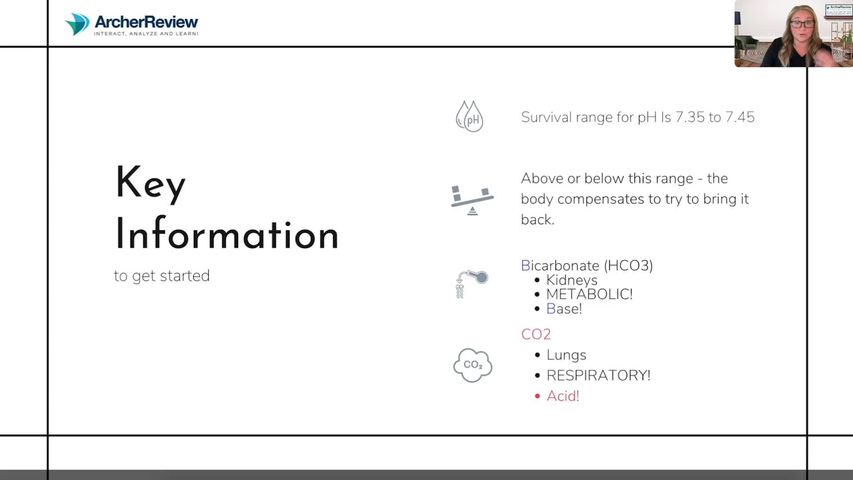
ABG Interpretation
2.6 ABG Interpretation
Additional Info
For a client receiving mechanical ventilation, clinical indicators that they are ready for weaning include their ability to take spontaneous breaths, oxygenate themselves at a reasonable FiO2 level, a normalized pH, and hemodynamic stability.
When caring for a client on a ventilator, you should be familiar with the following settings:
- Mode (Volume [SIMV, A/C] or Pressure [PSV])
- Rate (Number of breaths per minute)
- Tidal volume (the amount of gas delivered to the client)
- Fraction of inspired oxygen (FiO2 - the percentage of oxygen given per breath)
- PEEP (pressure added at exhalation to keep the small airways open and mitigate atelectasis)
- Pressure support (PS - provides added pressure when the client takes a spontaneous breath)
