A nurse is speaking to parents about their toddler. The parents express concern that the child is becoming independent, stating they want to always tend to the toddler. How should the nurse address the parents' apprehension regarding their toddler's burgeoning independence?
A nurse is speaking to parents about their toddler. The parents express concern that the child is becoming independent, stating they want to always tend to the toddler. How should the nurse address the parents' apprehension regarding their toddler's burgeoning independence?
A. “Your child may develop mistrust if not allowed to be independent.”
[14%]
B. “Your child may develop shame if not allowed to be independent.”
[49%]
C. “Your child may feel guilt if not allowed to be independent.”
[11%]
D. “Your child may feel inferior if not allowed to be independent.”
[26%]
Statistics
Subject/Lesson
Subject
Child Health
Lesson
Growth & Development
Client Need
Test Plan
Health Promotion and Maintenance
Related Topic
Development Stages and Transitions
Item Type
Item Type
Application
Explanation
Choice B is correct. Toddlers experience a sense of shame when they are not allowed to develop autonomy. Autonomy versus shame and doubt is the second stage of Erikson's psychosocial development and occurs during the toddler age. It is essential to allow the toddler to develop a sense of autonomy.
Choice A is incorrect. Under Erikson's Theory of Psychosocial Development, the trust versus mistrust stage is the first developmental milestone occurring during infancy. Infants develop mistrust during this stage when their needs are not consistently gratified.
Choice C is incorrect. Based on Erikson's Theory of Psychosocial Development, preschoolers are in the initiative versus guilt stage. During this period, guilt is developed if the preschooler fails to develop a sense of initiative.
Choice D is incorrect. According to Erikson, failure to develop a sense of accomplishment or industry in school-age children may result in a sense of inferiority.
Learning Objective
When speaking to the parents of a toddler who express concern regarding the child's independence and their tendency always to want to tend to the toddler, identify the most appropriate response for the nurse as "[y]our child will develop shame."
Related Videos
3 Key Topics
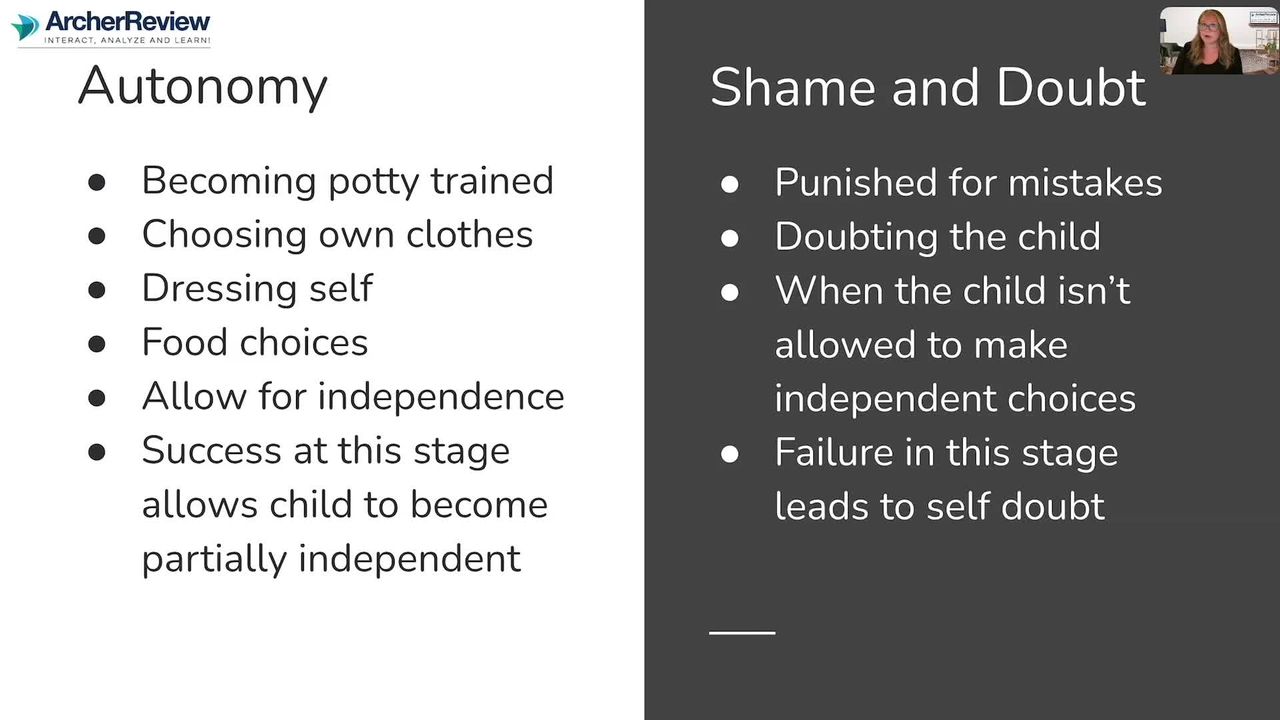
Toddler Growth and Development
14.8 Toddler Growth and Development
Additional Info
✓ Encourage parents to provide opportunities for their toddler(s) to explore and make choices within safe boundaries. Inform parents about age-appropriate activities that promote independence, such as self-feeding and dressing.
✓ This stage occurs roughly between the ages of 18 months to 3 years. Toddlers begin to assert their independence by exploring their environment and making choices. They may exhibit behaviors such as temper tantrums and defiance as they test boundaries and assert their autonomy.
✓ During the toddlerhood phase of psychosocial development, Erikson also focuses on the development of the ego (which also may be thought of as "reason" or "common sense").
