A client tells the nurse that they know their baby is in the "Trust vs. Mistrust" stage and want to learn more about it. An accurate explanation from the nurse would be:
A client tells the nurse that they know their baby is in the "Trust vs. Mistrust" stage and want to learn more about it. An accurate explanation from the nurse would be:
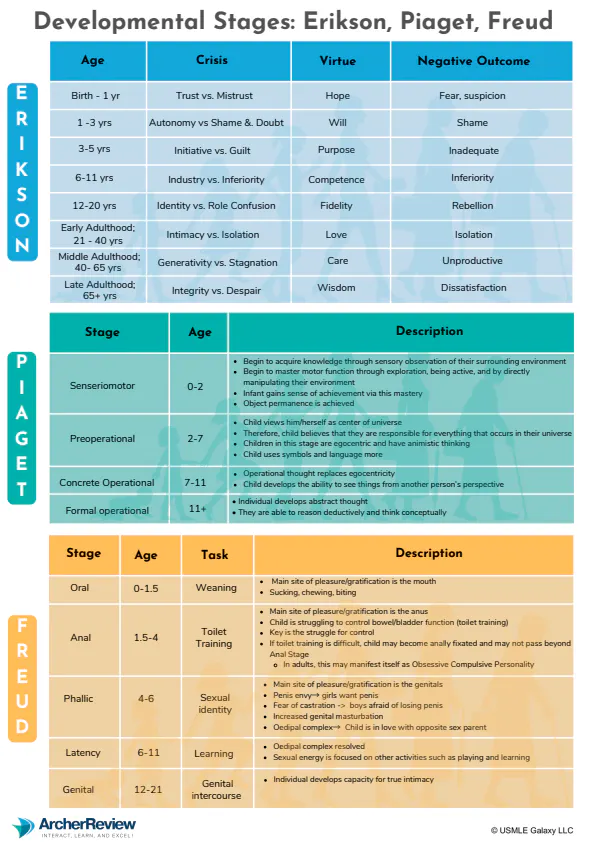
A. “Trust vs. Mistrust” is the first stage of development in Erikson’s theory that describes the eight developmental tasks everyone must face.
[89%]
B. It is a theory based on how an individual derives pleasure from different parts of the body.
[2%]
C. It is a theory that outlines the development of logical thinking.
[8%]
D. It is parallel to Selye’s adaptation theory.
[2%]
Statistics
Subject/Lesson
Subject
Child Health
Lesson
Growth & Development
Client Need
Test Plan
Health Promotion and Maintenance
Related Topic
Development Stages and Transitions
Item Type
Item Type
Knowledge/Comprehension
Explanation
Choice A is correct. "Trust vs. Mistrust" is the first of eight stages of Erikson's Stages of Psychosocial Development. During this stage, the child's psychosocial development is facilitated when the caregiver provides a secure environment with regular access to affection and food.
Choice B is incorrect. Theories of psychosexual development were developed by Freud and characterized by focusing on and deriving pleasure from different body parts.
Choice C is incorrect. Piaget's theory of cognitive development suggests that intelligence changes as children grow. Cognitive development occurs through the interaction of innate capacities and environmental events, and children pass through a series of stages. More specifically, Piaget's theory of cognitive development proposes four stages of development.
Choice D is incorrect. Hans Selye, known as the 'father of stress research,' disavowed the study of specific disease signs and symptoms, unlike others before him, and instead focused on universal client reactions to illness. Selye was the first to incorporate the term "stress" into the medical lexicon to describe the "nonspecific response of the body to any demand." Selye's methods and Erikson's theories are unrelated to one another.
Learning Objective
When a client requests to learn more about the "Trust vs. Mistrust" stage, identify the correct response as one which informs the client that this stage of development is the first of eight developmental tasks everyone must face, as described in Erikson's Stages of Psychosocial Development.
Related Videos
3 Key Topics
Infant Growth and Development
14.7 Infant Growth and Development
Additional Info
- Erikson's Stages of Psychosocial Development is a theory introduced in the 1950s by the psychologist and psychoanalyst Erik Erikson.
- It built upon Freud's theory of psychosexual development by drawing parallels in childhood stages while expanding it to include the influence of social dynamics as well as the extension of psychosocial development into adulthood.
- Stages arise as individuals grow and face new decisions and turning points during childhood, adolescence, and adulthood.