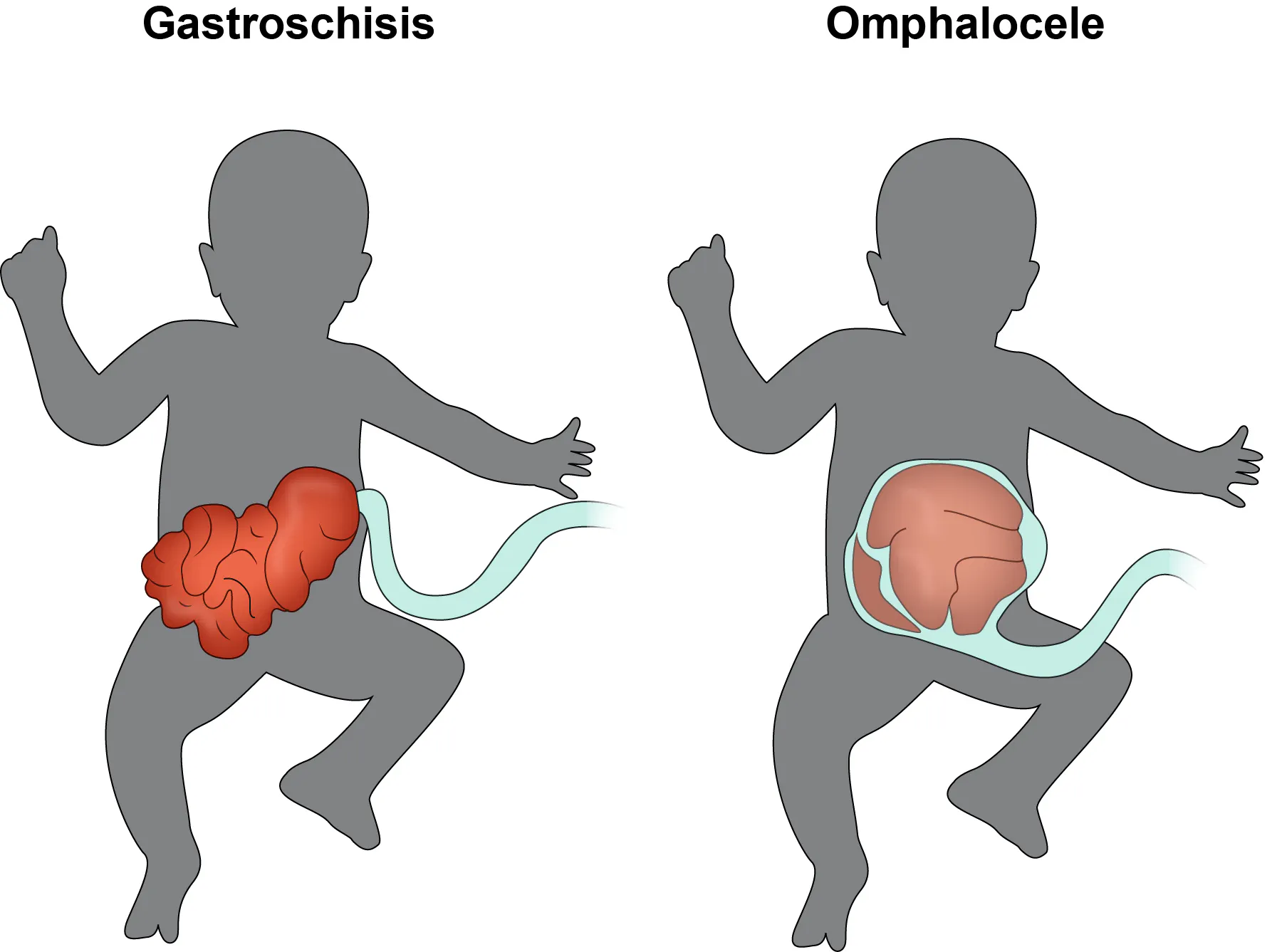
The nurse is caring for an infant with a congenital abnormality whose abdominal contents protrude through the umbilicus while remaining in the peritoneal sac. The nurse knows the infant will be diagnosed with which of the following?
The nurse is caring for an infant with a congenital abnormality whose abdominal contents protrude through the umbilicus while remaining in the peritoneal sac. The nurse knows the infant will be diagnosed with which of the following?
A. Intussusception
[12%]
B. Gastroschisis
[12%]
C. Omphalocele
[67%]
D. Hirschsprung’s disease
[9%]
Statistics
Subject/Lesson
Subject
Child Health
Lesson
Gastrointestinal
Client Need
Test Plan
Physiological Adaptation
Related Topic
Alterations in Body Systems
Item Type
Item Type
Knowledge/Comprehension
Explanation
Choice C is correct. This infant has an omphalocele. An omphalocele is a congenital abnormality where the abdominal contents come through the umbilicus while remaining in the peritoneal sac. Omphalocele is associated with an abdominal wall defect, and it occurs because the gut contents fail to rotate and return to the abdominal cavity during development. Advanced maternal age is a significant risk factor for omphalocele. With successful repair, 90% of infants with an omphalocele can survive.
Choice A is incorrect. Intussusception occurs when the bowel telescopes into another portion of the intestine. It is not characterized by the abdominal contents coming through the umbilicus while remaining in the peritoneal sac.
Choice B is incorrect. Gastroschisis is similar to omphalocele but differs in the fact that with gastroschisis, the intestines protrude outside the abdomen with no covering. This infant has an omphalocele because the abdominal contents come through the umbilicus while remaining in the peritoneal sac.
Choice D is incorrect. Hirschsprung's disease is when a large portion of the rectum is not correctly innervated, causing problems with passing stool. It is not characterized by the abdominal contents coming through the umbilicus.
Learning Objective
Recognize an omphalocele and differentiate it from gastroschisis.
Related Videos
4 Key Topics
Omphalocele
31.11 GI Obstructions & Abdominal Wall Defects
Gastroschisis vs Omphalocele