The nurse in the nursery is caring for a 24-hour-old infant. The nurse suspects the infant of having pyloric stenosis. Which of the following manifestations would support this finding?
The nurse in the nursery is caring for a 24-hour-old infant. The nurse suspects the infant of having pyloric stenosis. Which of the following manifestations would support this finding?
A. Melena
[2%]
B. Currant jelly stools
[9%]
C. Projectile vomiting
[84%]
D. Steatorrhea
[5%]
Statistics
Subject/Lesson
Subject
Child Health
Lesson
Gastrointestinal
Client Need
Test Plan
Physiological Adaptation
Related Topic
Alterations in Body Systems
Item Type
Item Type
Knowledge/Comprehension
Explanation
Choice C is correct. Projectile vomiting (i.e., vomiting accompanied by vigorous peristaltic waves) is typically associated with pyloric stenosis.
Choice A is incorrect. Melena is the passage of black, tarry stools that contain denatured (digested) blood and suggest an upper gastrointestinal source of bleeding. Melena is not a manifestation of pyloric stenosis.
Choice B is incorrect. Blood with mucus in the stool indicates an inflammatory or infectious condition, and currant jelly–like stools indicate vascular compromise, traditionally associated with intussusception.
Choice D is incorrect. The definition of steatorrhea is an increase in fat excretion in the stools. Steatorrhea is one of the clinical features of fat malabsorption and is noted in many conditions (i.e., exocrine pancreatic insufficiency, celiac disease, etc.). An increase in the fat content of stools results in the production of pale, large-volume, malodorous, loose stools. Steatorrhea is not an associated manifestation of pyloric stenosis.
Learning Objective
While caring for a 24-hour-old infant, a nurse suspects the infant of having pyloric stenosis. Identify the clinical manifestation most indicative of the nurse's suspicion as projectile vomiting.
Related Videos
2 Key Topics
Pyloric Stenosis
31.11 GI Obstructions & Abdominal Wall Defects
Additional Info
✓ Hypertrophic pyloric stenosis (HPS) occurs when the circumferential muscle of the pyloric sphincter becomes thickened, resulting in elongation and narrowing of the pyloric canal, producing an outlet obstruction and compensatory dilation, hypertrophy, and hyperperistalsis of the stomach.
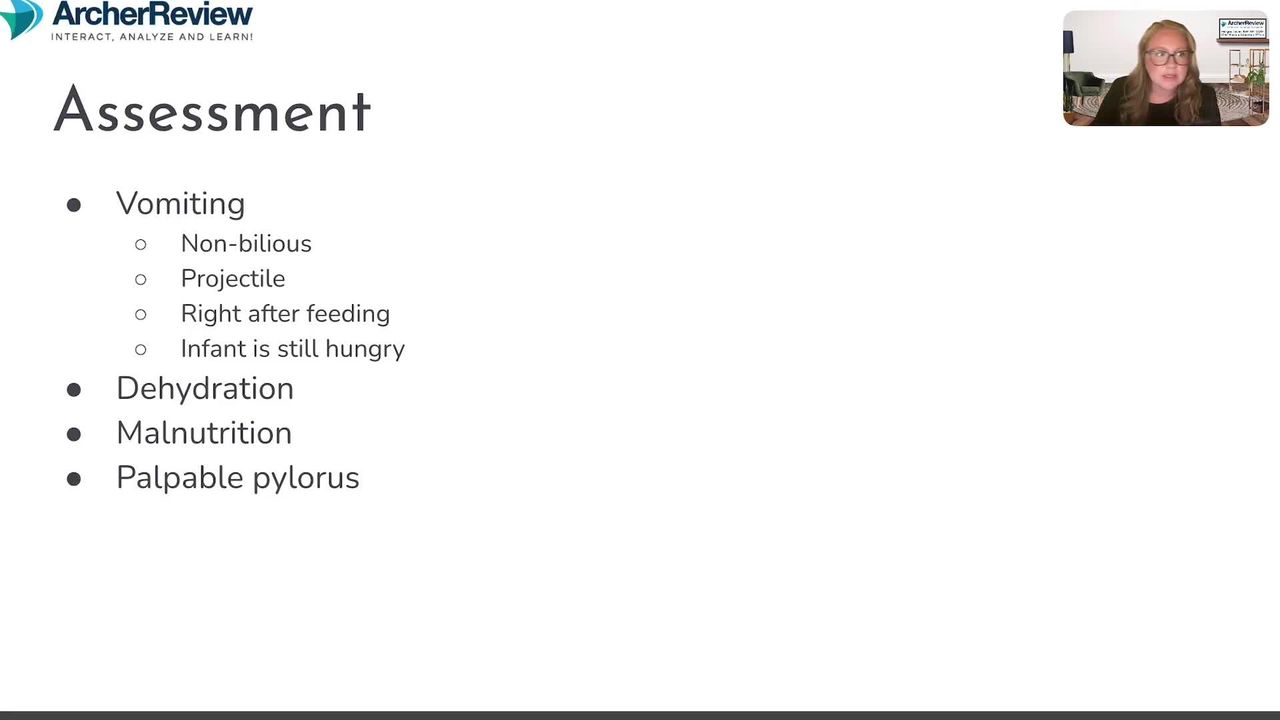
✓ This condition usually develops in the first few weeks of life, causing nonbilious vomiting, which occurs after a feeding; projectile vomiting may develop, and the infant is fussy and hungry after vomiting.
✓ Pyloric stenosis is usually diagnosed based on the symptoms, physical examination, and imaging studies such as an ultrasound. The most common treatment for pyloric stenosis is a surgical procedure called pyloromyotomy, which involves making a small incision in the thickened muscle to widen the pyloric channel and allow normal passage of food from the stomach into the small intestine. This surgery is highly effective and leads to a complete resolution of symptoms in affected infants.
