An 8-month-old infant has been brought into an emergency department (ED) for acute diarrhea and decreased oral intake. Which assessment finding would an ED nurse anticipate?
An 8-month-old infant has been brought into an emergency department (ED) for acute diarrhea and decreased oral intake. Which assessment finding would an ED nurse anticipate?
A. Skin tenting
[70%]
B. Low hematocrit
[8%]
C. Bulging anterior fontanels
[21%]
D. Weight gain
[1%]
Statistics
Subject/Lesson
Subject
Child Health
Lesson
Gastrointestinal
Client Need
Test Plan
Physiological Adaptation
Related Topic
Alterations in Body Systems
Item Type
Item Type
Application
Explanation
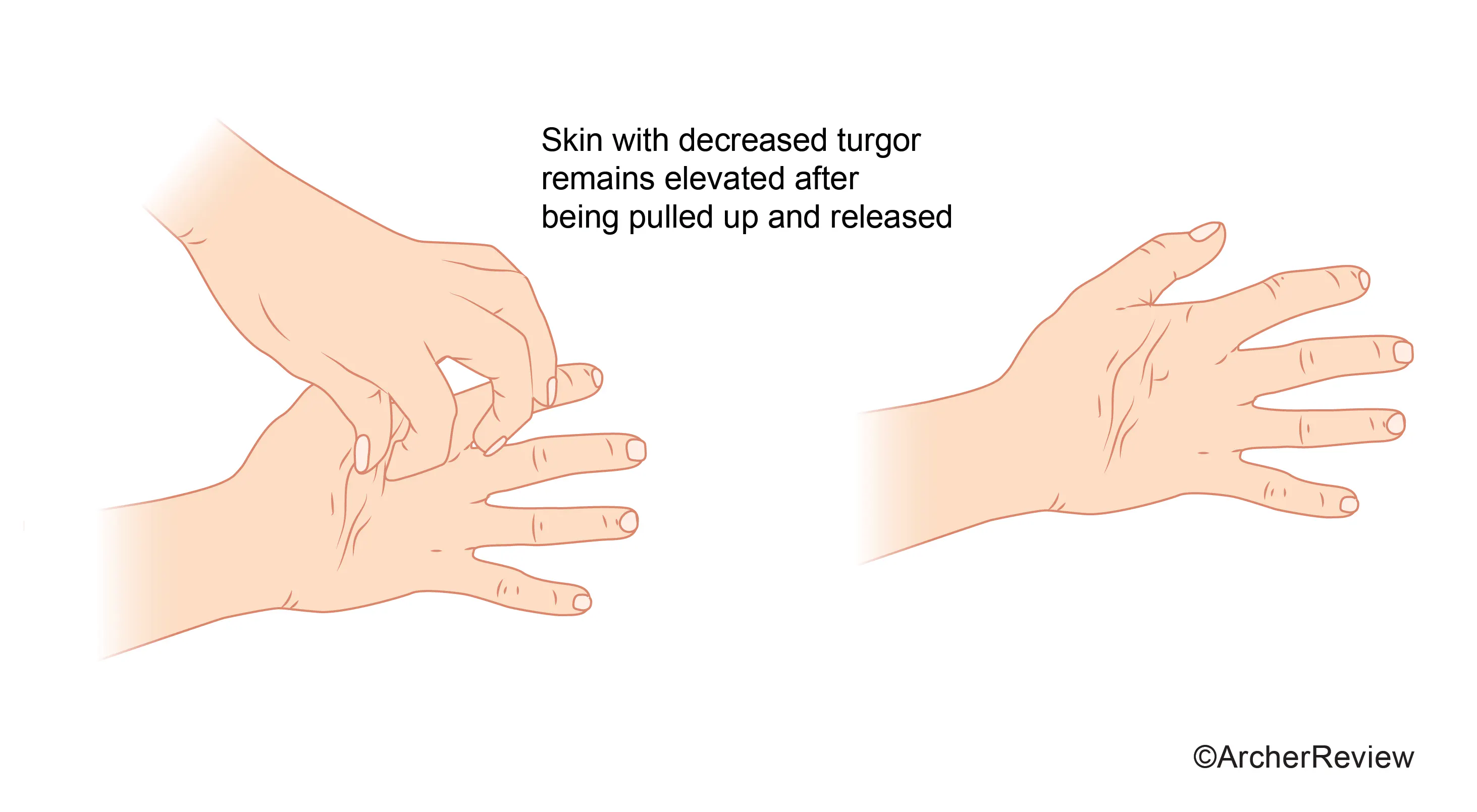
Choice A is correct. Decreased skin turgor is often present in dehydrated infants, resulting in the child's skin taking longer than average to return to a normal state after it has been pinched into a tent-like position. This response, known as skin tenting, would be an anticipated symptom in an infant with dehydration. Skin tenting in an individual with decreased skin turgor is demonstrated in the illustration above.
Choice B is incorrect. Dehydration and the related fluid volume loss result in increased hematocrit, not decreased. Dehydration lowers the water content in the body, including blood plasma levels. Lower plasma levels increase the ratio of red blood cells to blood volume, falsely increasing hematocrit levels (hemoconcentration).
Choice C is incorrect. Depressed anterior fontanelles are expected from a dehydrated infant. Bulging fontanelles are noticed in increased intracranial pressure and may suggest infections such as meningitis.
Choice D is incorrect. Weight loss occurs during diarrhea and dehydration. Weight gain would not arise.
Learning Objective
Recognize clinical features of dehydration.
Related Videos
2 Key Topics
Skin & Nails
14.6 Integumentary & System-Focused Assessment
Additional Info
- Dehydration is significant depletion of body water and, to varying degrees, electrolytes.
- Symptoms and signs include thirst, lethargy, dry mucosa, decreased urine output, and, as the degree of dehydration progresses, tachycardia, hypotension, and shock.
- Diagnosis is based on history and physical examination.
- Treatment is with oral or intravenous replacement of fluid and electrolytes.
