The nurse reviews cleft lip and cleft palate with a group of students. It would indicate effective teaching if the student states which are the following complications of both? Select all that apply.
The nurse reviews cleft lip and cleft palate with a group of students. It would indicate effective teaching if the student states which are the following complications of both? Select all that apply.
Statistics
Subject/Lesson
Subject
Child Health
Lesson
Gastrointestinal
Client Need
Test Plan
Reduction of Risk Potential
Related Topic
Potential for Complications from Surgical Procedures and Health Alterations
Item Type
Item Type
Knowledge/Comprehension
Explanation
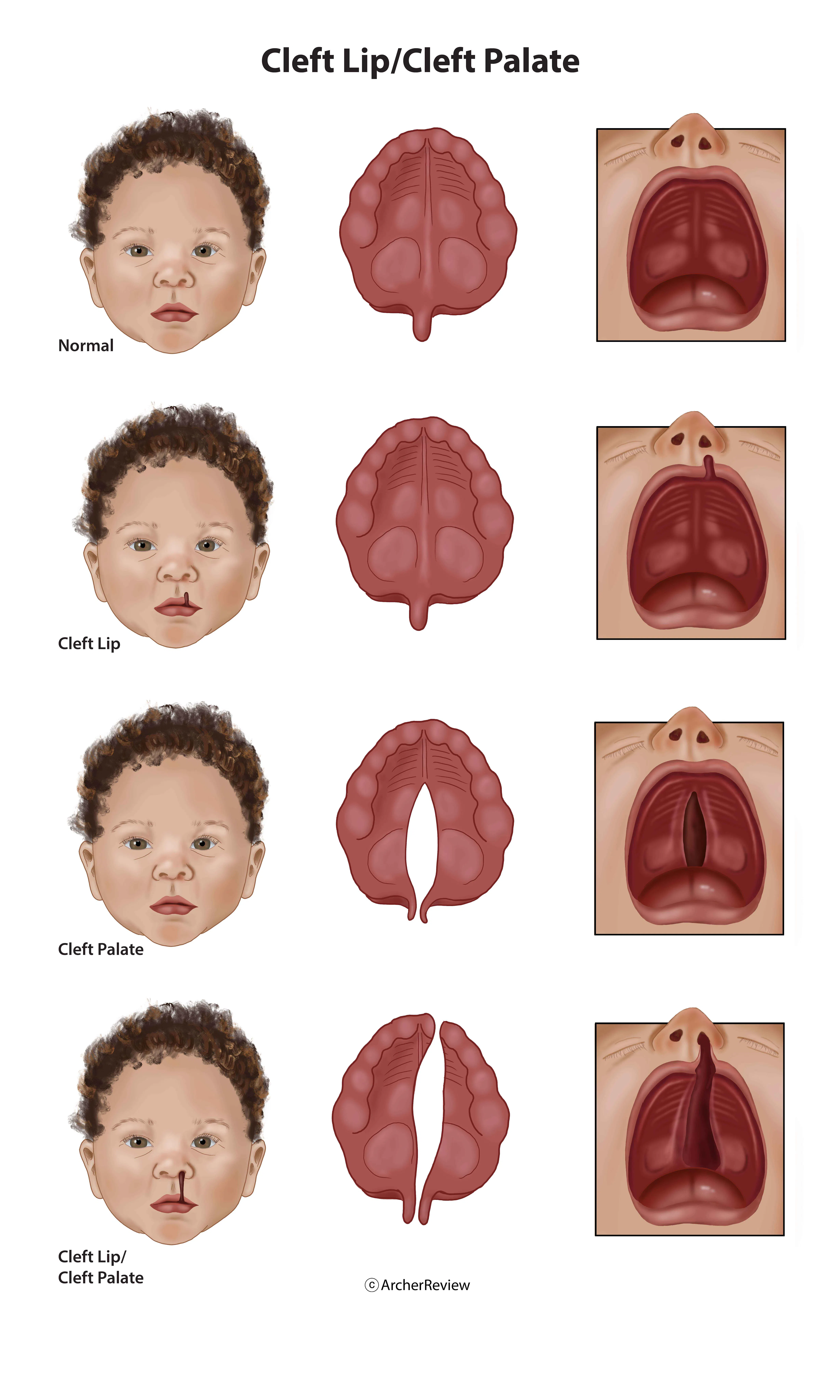
Choices A, B, and D are correct. When a child has a cleft lip and palate, the tissue and bone inside their mouth are not appropriately fused, meaning there is a space between their upper lip and palate. Ear infections will be a frequent complication for these clients due to the eustachian tube dysfunction, which connects the middle ear and the throat. Feeding issues are a common complication of cleft lip and cleft palate because it is harder for these infants to eat with the abnormality in their palate. The space in the roof of the mouth makes it very hard to suck and make a good seal around the bottle or nipple. Speech and language delays are common complications of cleft lip and palate. The roof of the mouth and lip have spaces that decrease muscle function and lead to delayed or abnormal speech. Eventually, many of these clients will require consultation with a speech-language pathologist.
Choices C and E are incorrect. Weight gain is not a common complication of cleft lip and cleft palate. With these abnormalities, it is much more difficult for the infant to eat, and they commonly experience feeding issues— leading to weight loss or failure to thrive, not weight gain. Esophageal reflux is not consistent with this condition and is associated with gastroesophageal reflux disease (GERD).
Related Videos
2 Key Topics
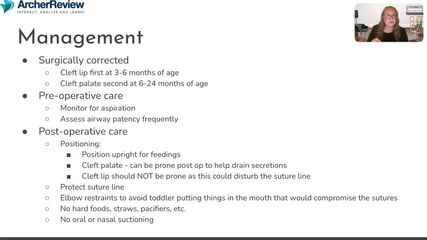
Cleft Lip & Palate
31.10 Craniofacial & Airway/GI Structural Defects
Additional Info
https://app.archerreview.com/test-screen/MjQzMzczNDk=/MTE3NzQ=
