The nurse supervises a new graduate caring for a child immediately following surgery to correct an imperforate anus (anorectal malformation). Which action by the new graduate requires follow-up? The new graduate
The nurse supervises a new graduate caring for a child immediately following surgery to correct an imperforate anus (anorectal malformation). Which action by the new graduate requires follow-up? The new graduate
A. positions the child side-lying prone position with the hips elevated.
[3%]
B. obtains a rectal temperature.
[93%]
C. auscultates bowel sounds in all four abdominal quadrants.
[1%]
D. secures the indwelling urinary catheter bag to the frame of the bed.
[2%]
Statistics
Subject/Lesson
Subject
Child Health
Lesson
Gastrointestinal
Client Need
Test Plan
Reduction of Risk Potential
Related Topic
Potential for Complications from Surgical Procedures and Health Alterations
Item Type
Item Type
Analysis
Explanation
Choice B is correct. Immediately following surgical repair of the imperforate anus, the surgical site is very fragile, and obtaining a rectal temperature may cause significant trauma to the suture line. This method of temperature is not recommended.
Choice A is incorrect. The child should be positioned side-lying prone position with the hips elevated or a supine position with the legs suspended at a 90-degree angle to the trunk to reduce edema and pressure on the operative site.
Choice C is incorrect. Auscultating bowel sounds and any other gastrointestinal assessment do not require follow-up because this is appropriate.
Choice D is incorrect. An indwelling urinary catheter is often placed temporarily to prevent urine from contaminating the surgical incision site. Thus, it is appropriate for the nurse to maintain urinary catheter patency by keeping it lower than the incision site and secured to the bed frame.
Related Videos
2 Key Topics
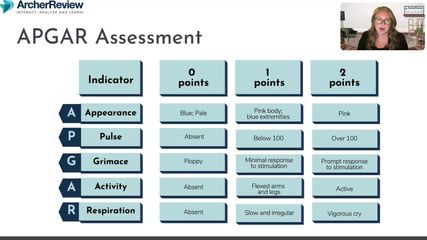
Newborn Assessment
31.1 Immediate Newborn Evaluation
Additional Info
✓ Manifestations associated with an anorectal malformation depend on the degree of severity but may include -
- Failure to pass a meconium stool
- Absence or stenosis of the anal rectal canal
- Presence of an anal membrane
- External fistula to the perineum
✓ Assess and manage the child's pain regularly, using age-appropriate pain assessment tools. Administer prescribed pain medications as ordered by the healthcare provider.
✓ Keep a watchful eye on fluid and electrolyte balance, especially in the early postoperative period. Ensure proper IV fluids and electrolyte replacement if needed.
