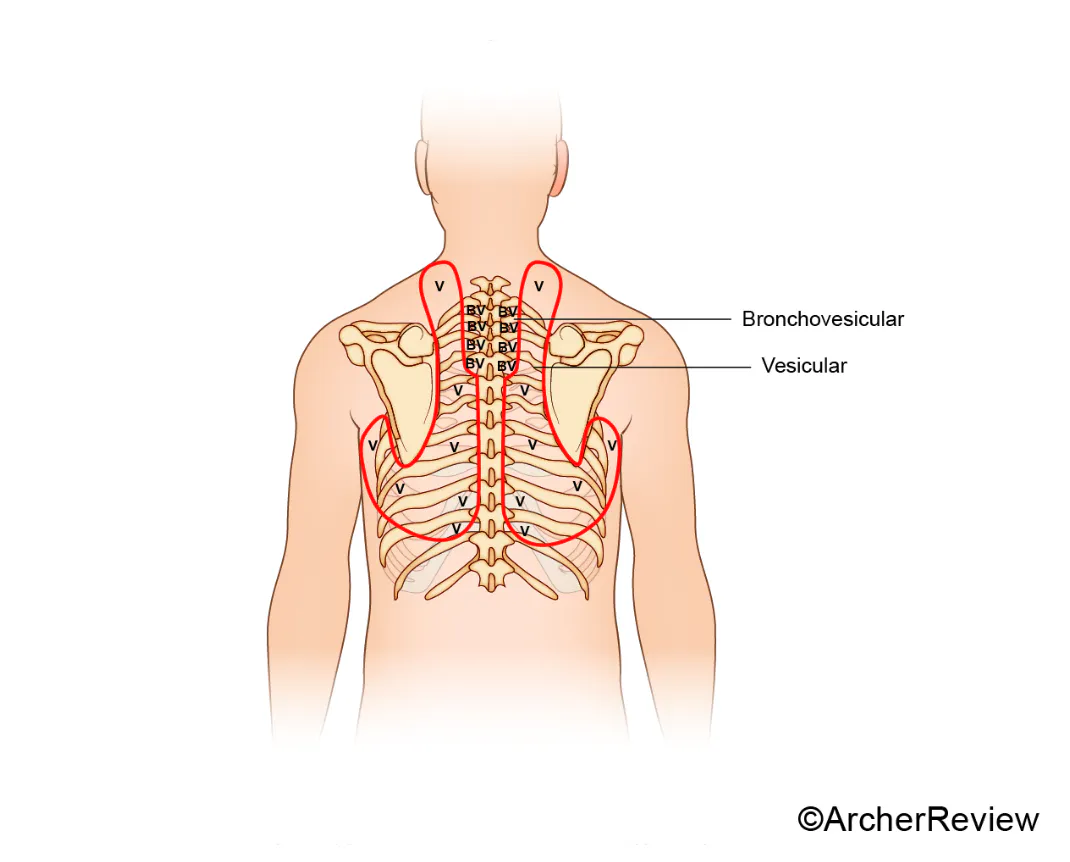
The nurse is performing a physical assessment on a client.
The nurse recognizes that when auscultating lung sounds, bronchovesicular lung sounds are best heard
The nurse is performing a physical assessment on a client.
The nurse recognizes that when auscultating lung sounds, bronchovesicular lung sounds are best heard
A. sixth intercostal space on the right side.
[18%]
B. midclavicular line, in the fifth intercostal space.
[32%]
C. posteriorly, between the scapula.
[39%]
D. over the trachea and larynx.
[10%]
Statistics
Subject/Lesson
Subject
Adult Health
Lesson
Respiratory
Client Need
Test Plan
Health Promotion and Maintenance
Related Topic
Techniques of Physical Assessment
Item Type
Item Type
Knowledge/Comprehension
Explanation
Choice C is correct. Bronchovesicular sounds occur over major bronchi where there are fewer alveoli. They are moderate in pitch and amplitude and are normally equal during inspiration and expiration. Posteriorly, bronchovesicular breath sounds can be auscultated between the scapulae.
Choice A is incorrect. The sixth intercostal space on the right side corresponds with the auscultation of the liver and gallbladder.
Choice B is incorrect. The midclavicular line in the fifth intercostal space is the apex of the heart where the apical pulse may be obtained, and any adventitious heart sounds such as S3 or S4 may be auscultated.
Choice D is incorrect. Auscultating lung sounds over the trachea is where the nurse may listen to bronchial breath sounds. These breath sounds are loud and high-pitched with hollow quality.
Related Videos
2 Key Topics
Auscultation
14.4 Assessment Techniques & Core Skills
Additional Info