The nurse cares for a client who sustained full-thickness thermal burns to 30% of their total body surface area (TBSA). Which of the following initial laboratory values would be expected?
The nurse cares for a client who sustained full-thickness thermal burns to 30% of their total body surface area (TBSA). Which of the following initial laboratory values would be expected?
A. Potassium 5.6 mEq/L (mmol) [3.5-5 mEq/L]
[67%]
B. Hematocrit 30% (0.30 L/L) [ Male: 42-52% Female: 37-47%, 0.38–0.50 L/L]
[26%]
C. BUN 14 mg/dL (5.0004 mmol/L)[10-20 mg/dL, 2.1–8.0 mmol/L]
[4%]
D. Glucose 89 mg/dL (4.94 mmol/L) [70-110 mg/dL, 4.0–11.0 mmol/L]
[3%]
Statistics
Subject/Lesson
Subject
Adult Health
Lesson
Integumentary
Client Need
Test Plan
Physiological Adaptation
Related Topic
F&E Imbalances
Item Type
Item Type
Analysis
Explanation
Choice A is correct. Hyperkalemia is an expected finding for a client with a significant burn (any full-thickness burn > 10% TBSA). This results from significant cellular damage, which allows intracellular potassium to leak.
Choice B is incorrect. Hematocrit measures the percentage of red blood cells in the total blood volume. In burn injuries, especially severe ones, there might be hemoconcentration, leading to an increase in hematocrit. A level of 30% (0.30 L/L) is low for both males and females, so this value would not be expected in a client with burns. Hemoconcentration may occur because of the loss of fluid volume.
Choice C is incorrect. Blood Urea Nitrogen (BUN) measures kidney function and can be influenced by various factors, including dehydration. In the initial stages of burns, especially when there is significant fluid loss, BUN levels might be elevated. However, a BUN level of 14 mg/dL (5.0004 mmol/L) falls within the normal range of 10-20 mg/dL [2.1–8.0 mmol/L] and is not significantly elevated.
Choice D is incorrect. Blood glucose levels can vary in response to stress, including burns. However, a glucose level of 89 mg/dL (4.94 mmol/L) is within the normal range of 70-110 mg/dL [4.0–11.0 mmol/L] and would not be unexpected in this scenario.
Related Videos
6 Key Topics
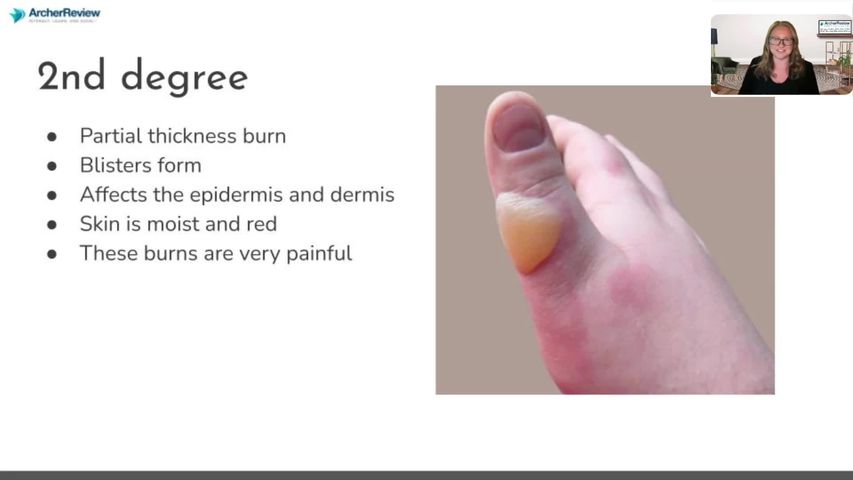
Burn Staging
25.7 Burns: Classification, Management & Complications
Burn Management
25.7 Burns: Classification, Management & Complications
Additional Info
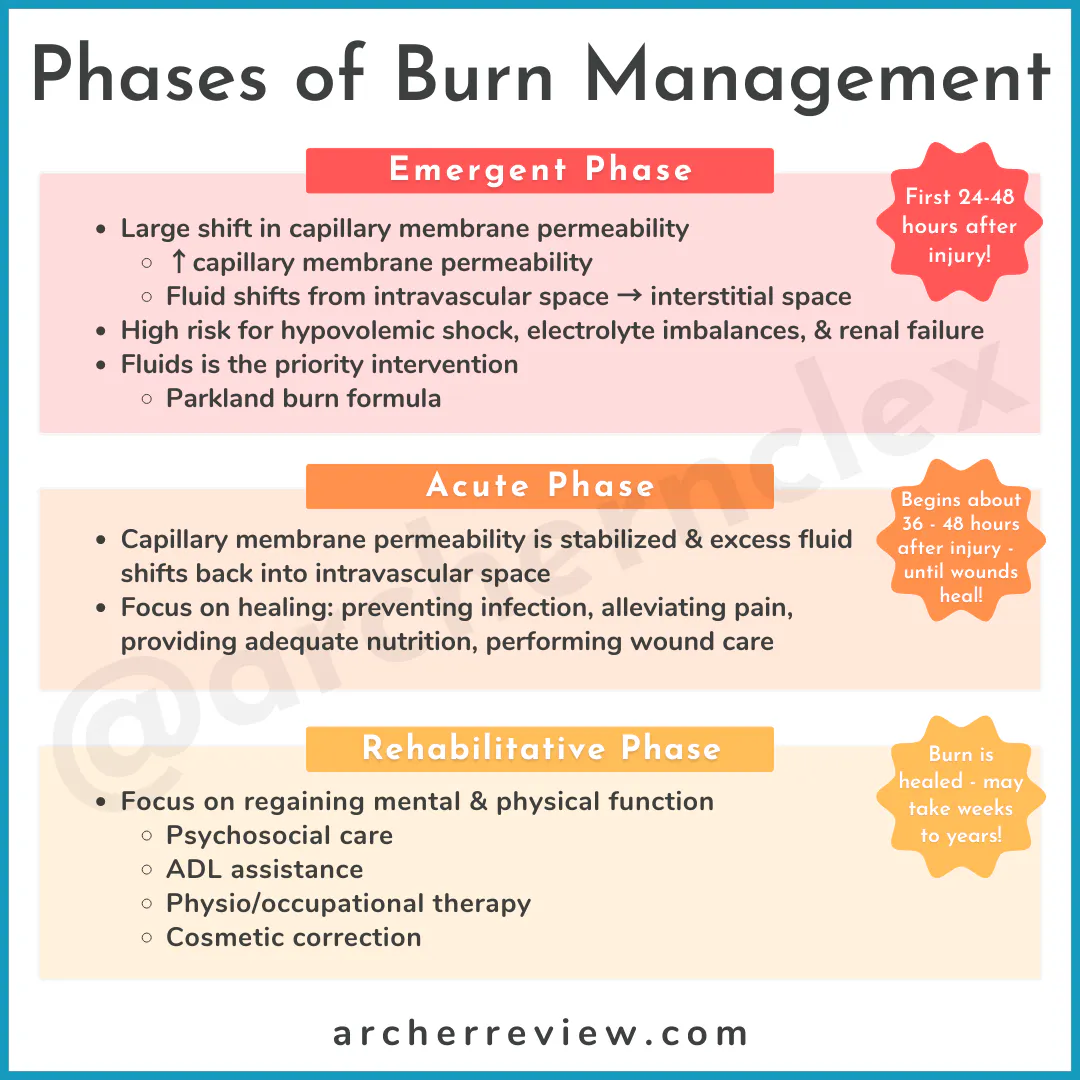
✓ Following a major thermal burn, the nurse should immediately:
- Assess airway patency
- Administer supplemental oxygen, as indicated
- Keep the client NPO
- Initiate IV line and telemetry monitoring
- Provide prescribed fluid resuscitation
- Keep the burns covered with sterile dressings
