The nurse is caring for a 31-year-old female four hours postoperative from a laparoscopic bariatric surgery.
Item 1 of 1
- Nurses' Notes
1910: Status post laparoscopic Roux-en-Y procedure. The client is fully alert and oriented. Glasgow Coma Scale was 15. The client reports pain at the incision as a ‘6’ out of 10 on the Numerical Pain Scale. Four surgical incisions were assessed as clean, dry, and approximated with skin glue. Bowel sounds were hypoactive in all four quadrants. Denies nausea. + Gag and cough reflex. The indwelling catheter was secured to the bed frame without kinks or loops. Clear, yellow urine was observed. Capillary blood glucose was obtained. Physician notified for admission orders.
- Medical History
- Morbid obesity (BMI 42)
- Uncontrolled diabetes mellitus
- Metabolic syndrome
- Heparin-induced thrombocytopenia
- Congestive heart failure
- Laboratory Results
1931: Capillary Blood Glucose 255 mg/dL [70-110 mg/dL] (14.2 mmol/L [3.9-6.1 mmol/L])
The nurse makes an entry in the nurses' notes and prepares to call the physician to request admission orders.
Select the anticipated provider orders from each of the following categories.
Each category must have at least one option selected, and each category may have more than one option selected.
The nurse makes an entry in the nurses' notes and prepares to call the physician to request admission orders.
Select the anticipated provider orders from each of the following categories.
Each category must have at least one option selected, and each category may have more than one option selected.
| Categories | Potential Order(s) |
|---|---|
Activity | Head of the bed semi-Fowler’s position Strict bed rest Keep head of the bed flat Out of bed to the chair |
Diet | Nothing by mouth (NPO) Clear liquids Full liquids Mechanically soft |
Medications | Naproxen Regular insulin via sliding scale Oxycodone-Acetaminophen Docusate sodium |
Consultations | Occupational therapy Registered Dietician Diabetic Educator Ostomy |
Venous Thromboembolism (VTE) Prophylaxis | No Pharmacologic VTE prophylaxis Fondaparinux via subcutaneous injection Intermittent pneumatic compression device Enoxaparin subcutaneous injection |
Statistics
Subject/Lesson
Subject
Adult Health
Lesson
Gastrointestinal
Client Need
Test Plan
Reduction of Risk Potential
Related Topic
Potential for Complications from Surgical Procedures and Health Alterations
Item Type
Item Type
GenerateSolutions
Explanation
Activity
- A significant complication following any bariatric surgery is venous thromboembolism (VTE). The client will be expected to ambulate within several hours after surgery.
- Mobilizing the client early will prevent complications such as VTE and pneumonia.
- Additionally, the client should have the head of the bed elevated to semi-Fowler's to improve breathing and decrease the risk of sleep apnea, pneumonia, or atelectasis.
- The client should ambulate to the chair within several hours after surgery.
- Strict bed rest would be detrimental to the post-op care of this client as it may allow for a VTE to form.
- HOB restrictions are not necessary following this surgery.
Diet
- The client has a positive gag reflex, no nausea, and has bowel sounds. All of these indicate that a clear liquid diet is appropriate.
- Hypoactive bowel sounds are common in the postoperative period. Absent bowel sounds would be concerning.
- If the client tolerates the clear liquid diet, the surgeon may advance the client to full liquids.
Medications
- The client has uncontrolled hyperglycemia; the nurse should anticipate an order for regular insulin via a sliding scale.
- The client is endorsing pain; adequate pain control is necessary to ensure optimal recovery. Oxycodone-acetaminophen is an appropriate choice.
- The client's decreased mobility and pain medication can cause reduced gastrointestinal motility. Thus, the client should be placed on docusate sodium to prevent constipation.
- The client has a medical history of congestive heart failure. Naproxen (and other NSAIDs) are contraindicated because of their propensity to lead to fluid retention.
Consultations
- A registered dietician should be consulted to assist the client with making appropriate food choices following this surgery. Dieticians work closely with clients who have undergone bariatric surgery.
- The client has a documented history of uncontrolled diabetes and is experiencing hyperglycemia. The nurse should consult a diabetic educator to educate the client on diabetes management.
- Occupational therapy is not necessary. This client does not have any deficits requiring management of how to perform their activities of daily living.
- An ostomy consultation is not necessary because this client does not have the creation of any ostomies (urostomy, colostomy, etc.).
VTE prophylaxis
- VTE is a significant risk factor following this procedure. The nurse should work to mitigate this risk by applying sequential compression stockings and administering prophylactic anticoagulant therapy.
- The client has a documented history of heparin-induced thrombocytopenia (HIT). The client should not receive any heparin products such as enoxaparin.
- Considering the client has a documented history of HIT, the client should receive chemical prophylaxis with fondaparinux.
Related Videos
2 Key Topics
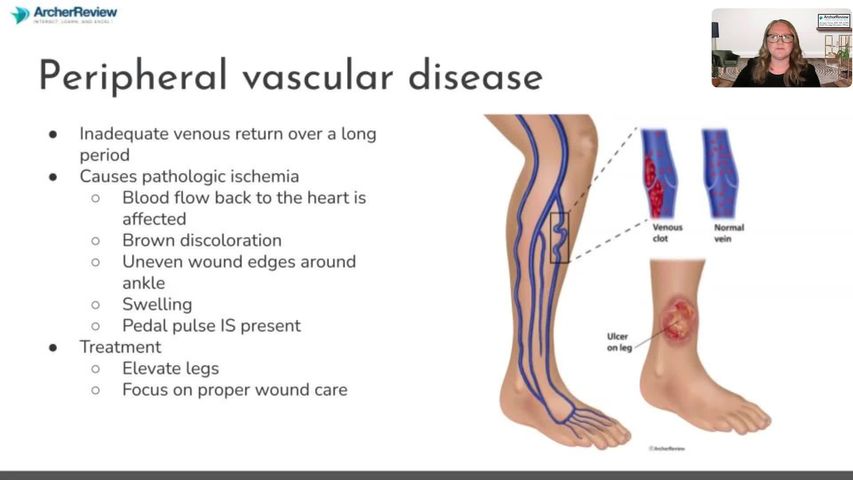
Deep Vein Thrombosis
18.7 Venous Disorders
Additional Info
✓ Bariatric surgery is a life-altering procedure that requires a coordinated effort to prevent post-operative complications.
✓ Complications of bariatric surgery include venous thromboembolism, pneumonia, severe vitamin and mineral deficiencies, and dumping syndrome.
✓ Bariatric surgery may be indicated if one of the following clinical criteria has been met:
• The client has not responded to traditional interventions
• Has a body mass index (BMI) of 40 or greater
• Has a BMI of 35 or greater, with other health risk factors
