The emergency department (ED) nurse is caring for a 66-year-old male client
Item 1 of 1
- History and Physical
2000: 66-year male arrives at the emergency department (ED) following a recommendation by his primary healthcare provider (PHCP). The client called his PHCP in the morning, reporting a headache, feeling unwell, fatigue, and thirst. He could not check his blood glucose because he reports being out of testing supplies for two weeks. He also reports being unable to take his prescribed antihypertensive and antidiabetic medications for one week because he lost his job. On exam, the client reports feeling fatigued and thirsty. He is alert and completely oriented. His physical exam was within normal limits except for a thready pulse with a rate of 119/minute.
The client has a medical history of type II diabetes mellitus, congestive heart failure (CHF), hypertension, and hyperlipidemia. He is prescribed atorvastatin, metformin, and lisinopril.
- Vital Signs
- Oral Temperature 98o F (36.7o C)
- Pulse 119/minute
- Respirations 19/minute
- Blood pressure 98/52 mm Hg
- Oxygen saturation 96% on room air
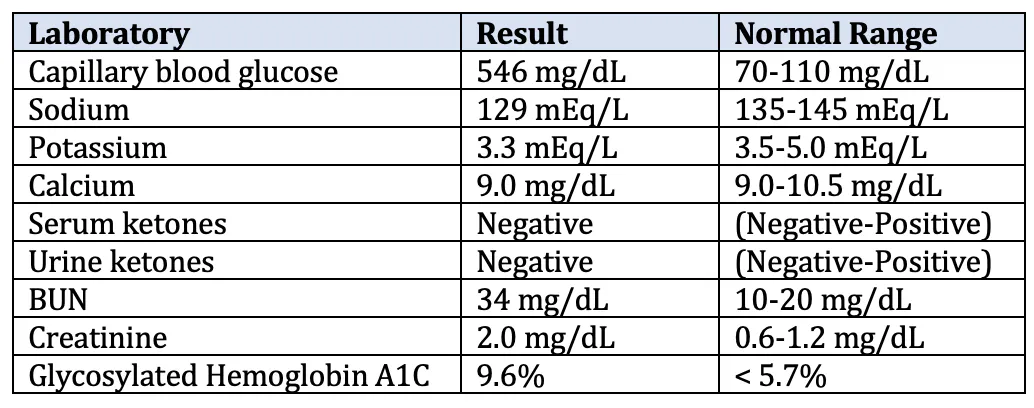
- Laboratory
- Physician Orders
- Obtain intravenous (IV) access
- Five units of regular insulin via intravenous push (IVP)
- Infuse two liters of 0.9% saline over one hour
- Obtain capillary blood glucose (CBG) every two hours
- Potassium chloride 20 mEq by mouth x 1 dose
- Implement seizure precautions
The nurse reviews laboratory work ordered by the primary healthcare provider (PHCP)
The nurse obtains physician orders for this client with hyperosmolar hyperglycemic state (HHS)
The nurse is preparing to implement the physician's orders. Which order should the nurse clarify with the physician?
The nurse reviews laboratory work ordered by the primary healthcare provider (PHCP)
The nurse obtains physician orders for this client with hyperosmolar hyperglycemic state (HHS)
The nurse is preparing to implement the physician's orders. Which order should the nurse clarify with the physician?
Statistics
Subject/Lesson
Subject
Adult Health
Lesson
Endocrine
Client Need
Test Plan
Physiological Adaptation
Related Topic
Illness Management
Item Type
Item Type
GenerateSolutions
Explanation
- The priority treatment for a client with HHS is the repletion of fluids as the client is grossly dehydrated.
- The clinical standard is one liter of isotonic saline per hour, and the client's electrolytes are assessed throughout the correction.
- The client has a history of congestive heart failure, and two liters of saline in one hour may be highly detrimental, and this order should be clarified with the PHCP. Finally, the nurse should recognize that correcting the dehydration should be done slowly because of the client's sodium level.
- A correction that goes unmonitored or too fast may cause cerebral edema.
- The client's potassium level is low, and the order for potassium replacement is appropriate.
- Potassium depletion is common in HHS because of the metabolic alkalotic state it causes.
- Obtaining capillary blood glucose every two hours for a client with HHS is appropriate. This is the clinical standard.
- Hourly glucose monitoring should be performed for a continuous insulin infusion. This client is not getting a continuous insulin infusion.
NCLEX Strategy Spotlights
Related Videos
2 Key Topics
Diabetes Mellitus Type II
