The nurse is discussing cardiac dysrhythmias with a student. Which of the following statements, if made by the student, would indicate effective understanding?
The nurse is discussing cardiac dysrhythmias with a student. Which of the following statements, if made by the student, would indicate effective understanding?
A. “Atrial fibrillation may cause venous thromboembolism.”
[19%]
B. “Immediate defibrillation is needed for asystole.”
[13%]
C. “Cardioversion may be used for ventricular fibrillation.”
[12%]
D. “Adenosine is used to treat supraventricular tachycardia.”
[55%]
Statistics
Subject/Lesson
Subject
Adult Health
Lesson
Cardiovascular
Client Need
Test Plan
Physiological Adaptation
Related Topic
Medical Emergencies
Item Type
Item Type
Analysis
Explanation
Choice D is correct. Adenosine is the initial medication utilized to manage supraventricular tachycardia (SVT). This medication slows the conduction time through the AV node and restores normal sinus rhythm.
Choices A, B, and C are incorrect. Atrial fibrillation does lead to a potential thrombus that may evolve into an embolism; however, it does not cause venous thromboembolism because the blood pooling in the left atrial appendage gets ejected into the arterial circulation, not venous. Thus, the most likely complication is an embolic stroke. Asystole is treated with high-quality CPR and IV epinephrine. Defibrillation is not indicated for asystole. Ventricular fibrillation responds to defibrillation, not cardioversion. Defibrillation delivers a higher amplitude of joules and does not need to be synchronized. Cardioversion can only be done if the client has a pulse.
Related Videos
11 Key Topics
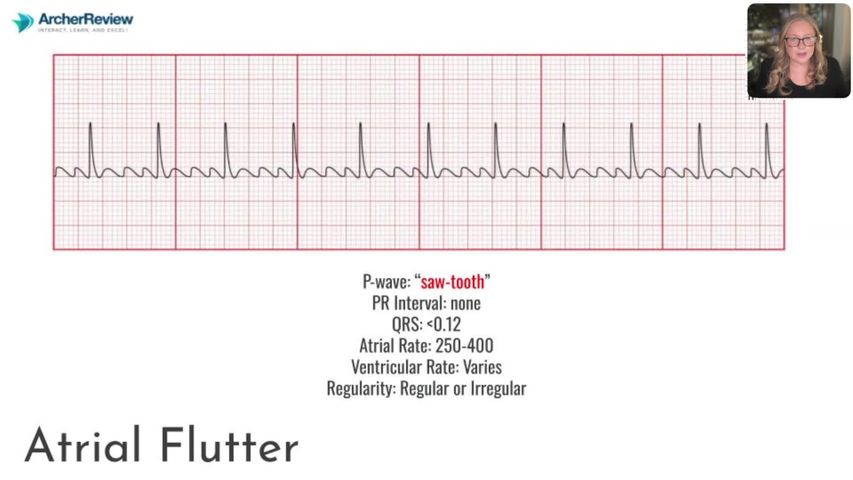
Atrial Fibrillation
7.5 Atrial Dysrhythmias
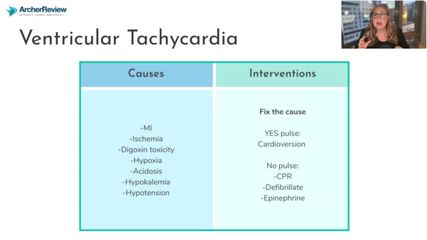
Ventricular Fibrillation
7.6 Ventricular Dysrhythmias & Cardiac Arrest
Supraventricular Tachycardia
7.5 Atrial Dysrhythmias
Cardioversion vs. Defibrillation
7.6 Ventricular Dysrhythmias & Cardiac Arrest
Asystole
7.6 Ventricular Dysrhythmias & Cardiac Arrest
Additional Info
Supraventricular tachycardia (SVT) is a tachycardia that is caused by an impulse recirculating throughout the atrial pathway. Adenosine is used to treat SVT; before giving this medication, the nurse must have the client connected to a cardiac monitor and have a defibrillator as well as a crash/code cart nearby. The client should have the pads affixed to them just in case the medication causes a prolonged period of asystole. The medication must be pushed by rapid IV push along with an immediate flush of 0.9% saline.
